
 English
 日本語
日本語 한국어
한국어 中文(廣東話)
 Tagalog
 ไทย
ไทย Tiếng Việt
 Chuukese
Why veterans' knees wear out early
Military service loads knees like few other careers: loaded marches, repeated jumps, hard landings, flight-deck surfaces, decades of running in boots. Studies of veteran populations consistently show higher rates of knee osteoarthritis — and at younger ages — than the civilian population. If your knee aches on stairs, swells after activity, keeps you off the hikes and out of the surf, and X-rays show bone-on-bone arthritis, you're not "too young" and it isn't "just wear and tear you live with." It's a treatable condition with a well-defined ladder of options, from arthritis care and injections up to knee replacement.
Using VA Community Care: the actual steps
Veterans don't have to leave the VA system to see Dr. Morton — the VA's Community Care program exists precisely so veterans can get timely specialty care close to home when VA facilities can't provide it within drive-time and wait-time standards. The pathway:
- Tell your VA provider you'd like a community-care referral for orthopedic evaluation of your knee (or hip) with Dr. Paul Morton at Pacific Bone & Joint.
- The VA issues the referral and authorization. Eligibility commonly comes from drive-time/wait-time standards or the VA's best-medical-interest determination.
- Our office takes it from there — we coordinate the authorization, schedule your consultation in Honolulu, West O‘ahu, Hilo, or Kona, and handle the paperwork with the VA, including surgical authorization if you and Dr. Morton decide on replacement.
TRICARE beneficiaries — active duty family members, retirees, and Guard/Reserve — are also accepted, as are veterans using Medicare. See the full insurance list.
What a modern knee replacement looks like here
If you had a buddy get a knee replaced in the 2000s, forget most of what he told you:
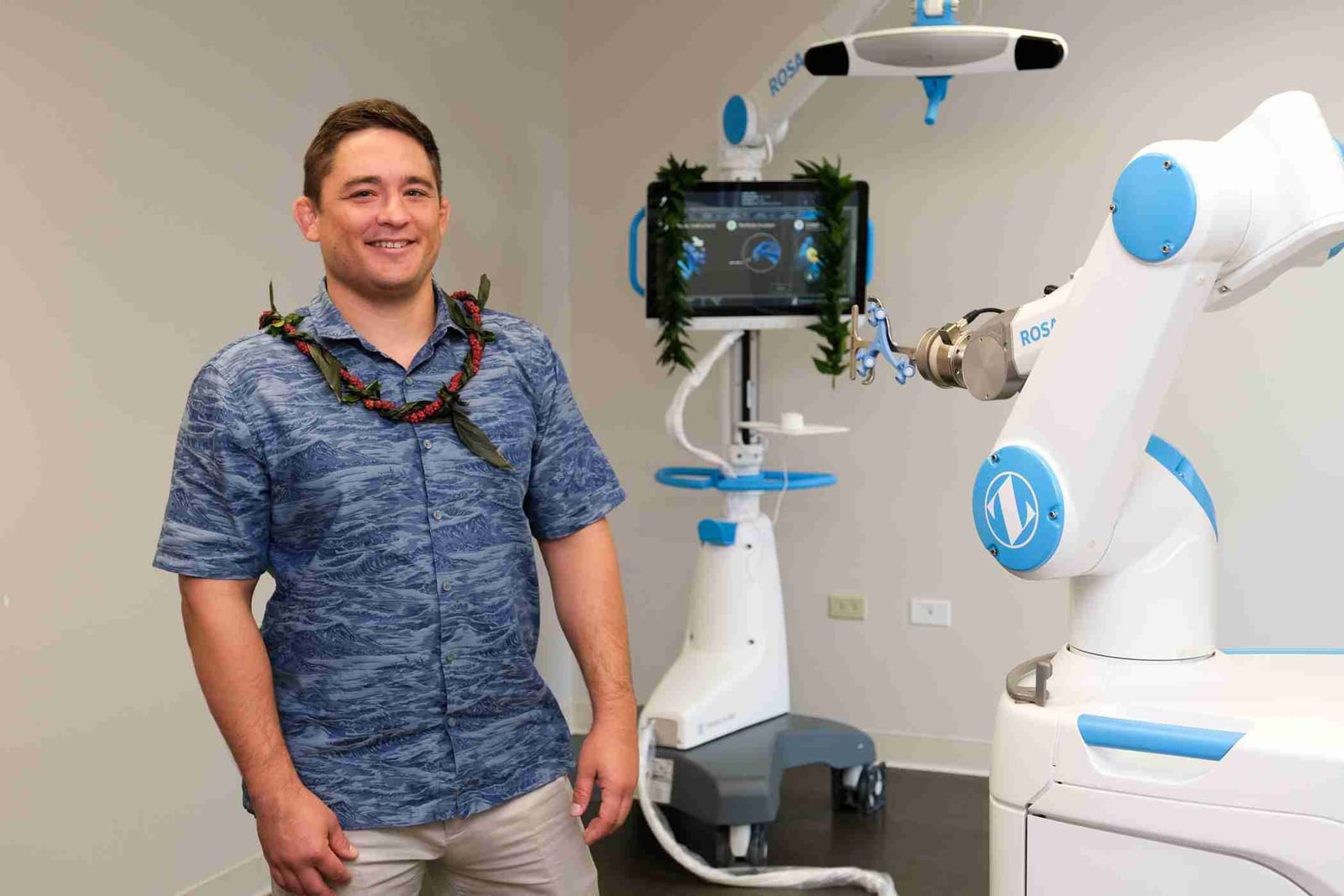
- Robotic assistance positions the implant to your anatomy with sub-millimeter verification — Dr. Morton is certified on all four major platforms (ROSA®, Mako, CORI, VELYS) and performed Hawai‘i's first robotic hip replacement.
- The subvastus approach goes under your quad muscle instead of cutting through it — you keep the leg strength you'll use to get back up.
- No tourniquet and opioid-sparing anesthesia — a point that matters to many veterans who want nothing to do with narcotics. Most patients need dramatically less opioid medication than a decade ago, and many walk the day of surgery.
- Same-day surgery for healthy candidates — home (not a hospital ward) by evening.
- Big Island veterans: robotic knee replacement happens on-island at Hilo Community Surgery Center with the Mako robot — no flight to O‘ahu for most primary replacements.
Service-connected disability and your knee
If your knee condition is service-connected, surgery and its documentation can intersect with your disability rating — knee replacement carries its own rating schedule. Dr. Morton's office provides thorough operative and follow-up documentation you can submit with VA paperwork, and an independent medical examination service exists for cases that need a formal orthopedic opinion. (For rating questions themselves, your VSO or the VA remains the right resource.)
Medically reviewed by Paul N. Morton, MD, FAAOS, FAAHKS — board-certified orthopedic surgeon, fellowship-trained in adult hip & knee reconstruction and orthopedic trauma.
This page is for education only and isn’t a substitute for an exam and personalized advice — schedule a consultation to discuss your situation.