
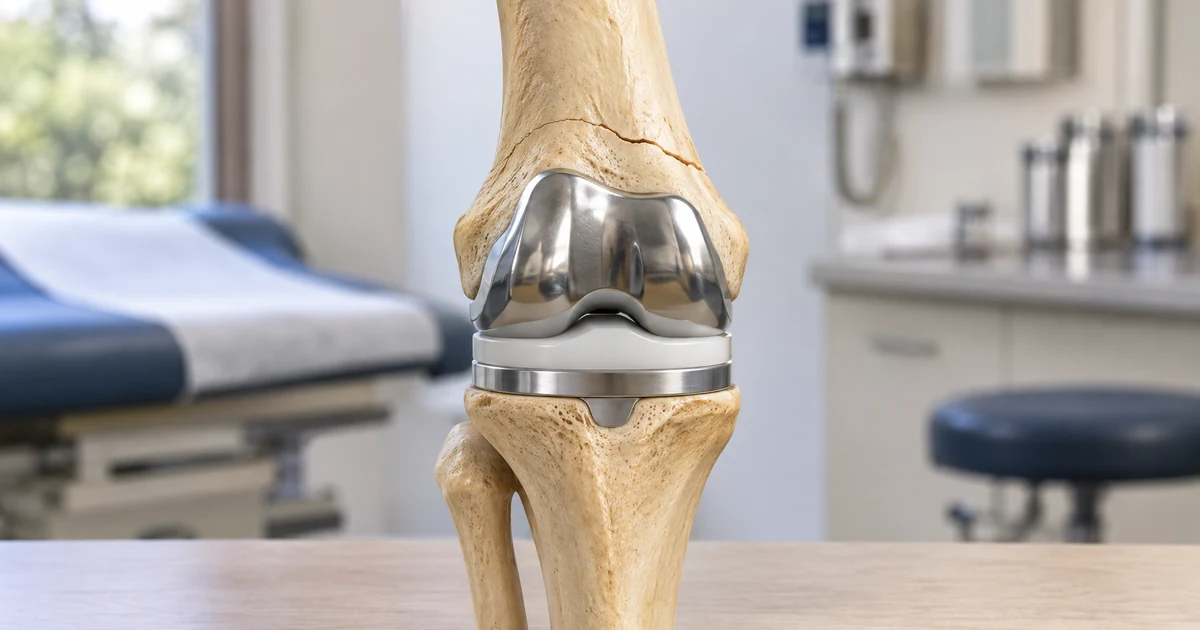
What is a fracture around a knee replacement?
A periprosthetic fracture is a break in bone near an existing joint implant. After total knee replacement, that could involve the lower femur above the replacement, the upper tibia below it, or the patella. The femur is the most common location. These injuries may occur months or many years after the original replacement, often after a fall. A painful fall does not automatically mean the implant is broken, but a possible fracture requires prompt medical evaluation.
This guide focuses on the first decisions after a fall, why surgeons examine both the bone and the implant, and how treatment differs from routine knee pain. It does not replace emergency assessment. [1]
When should you seek emergency care?
Go to an emergency department now if you have severe pain after a fall, cannot stand or bear weight, see an obviously crooked or shortened leg, have an open wound over the injury, or have a new cold, pale, numb, or weak foot. Call 911 if you cannot travel safely or have a serious associated injury. Do not test the leg repeatedly by walking on it.
If the pain seems modest but the knee or thigh remains painful, swollen, or difficult to use after a fall, arrange urgent assessment. Some fractures are not obvious without imaging. People with weakened bone, previous revision surgery, or longstanding implant discomfort should have a particularly low threshold for evaluation. [1, 2]
What to do before you are evaluated
Avoid weight bearing on the injured leg until a clinician determines it is safe. Keep the limb supported in the most comfortable position; do not attempt to straighten a visibly deformed leg or manipulate the implant. If you have a brace or walking aids, use them only as directed and do not let them substitute for emergency care when red flags are present.
Bring your medication list, especially any blood thinners, and the date and location of your original knee replacement if known. If you have a knee implant card, operative report, or previous X-rays, tell the team where to obtain them. You do not need to delay urgent evaluation to collect paperwork. [1, 3]
Why the examination looks beyond the knee
The care team checks the skin, bruising, wounds, swelling, leg alignment, and whether nerves and circulation to the foot are functioning normally. Pain may be centered above the knee even though the injury involves the replacement. The team also asks whether there was thigh or knee pain before the fall, whether the replacement felt unstable, and whether an infection had previously been suspected.
Those details matter because a fracture can occur around an otherwise well-fixed replacement, or around a component that was already loose. A history of progressive pain, declining function, prior infection, or multiple operations changes the assessment and may change surgery planning. [1, 3]
X-rays first; CT when the answer is incomplete
The initial evaluation generally includes X-rays of the injured knee and the full length of the relevant femur or tibia. The pictures show where the break occurs relative to the implant, whether the pieces are displaced, how much usable bone remains, and whether the component appears well fixed. Previous imaging helps identify preexisting changes.
A CT scan may clarify a complex fracture, small fracture lines, bone loss, or the relationship between a break and an implant when regular radiographs are insufficient. Blood tests may be obtained to evaluate general health and prepare for surgery. If history or examination raises suspicion for joint infection, the team may use additional testing; an injured knee is not automatically infected. [1, 2, 3, 4]
The key decision: is the implant still stable?
Two patients with fractures in nearly the same place can need different operations. If the knee replacement is solidly attached to the bone and the fracture can be reconstructed, surgeons may stabilize the bone with plates and screws, or sometimes an intramedullary nail, depending on implant design and fracture anatomy. This is called open reduction and internal fixation (ORIF).
If a component is loose, the bone stock is too poor for reliable fixation, or the fracture is not reconstructable with an acceptable functional result, the plan may involve revision knee replacement using longer stems, more constrained components, or reconstruction of deficient bone. Some cases need a combination of fracture fixation and revision. The goal is stable fixation and a safe path to rehabilitation, not a single preferred operation for every patient. [1, 3]
Why bone quality and previous symptoms matter
Osteoporosis, impaired balance, muscle weakness, and falls can increase vulnerability to fracture. Studies identify osteoporosis among the factors associated with periprosthetic fractures, but those findings do not predict what will happen to an individual patient. During recovery, it may be appropriate to discuss bone health assessment and fall prevention with the treating team. [1, 5]
Pre-injury pain also deserves attention. A patient whose knee was increasingly painful or unstable before the fall may have a loose component or another problem requiring a separate diagnostic plan. Treating only the broken bone without recognizing a preexisting failing implant can leave an important issue unresolved. [3]
Is every fracture treated with surgery?
Most displaced fractures around a total knee replacement need surgery, often because stable alignment and timely rehabilitation would otherwise be difficult. Selected stable, nondisplaced fractures may be managed with immobilization and close follow-up, but that decision requires orthopedic imaging review and reliable monitoring. The choice depends on fracture location, implant fixation, bone quality, health conditions, and the person's ability to follow weight-bearing limits. [1]
Surgeons also consider wound risk, medical optimization, mobility before injury, availability of support at home, and the hazards of prolonged immobility. A fracture around a knee replacement is generally more complex than an uncomplicated bone break, so coordinated trauma and arthroplasty expertise may be useful.
Recovery varies by the fracture and reconstruction
The rehabilitation plan is individualized. Some stable reconstructions permit earlier movement or loading; others require weeks of protected weight bearing while the bone heals. A brace, walker, or crutches may be required. The care team will give specific instructions for safe transfers, knee motion, physical therapy, wound care, clot prevention when appropriate, and follow-up X-rays.
Compared with uncomplicated primary knee replacement, fracture treatment commonly involves a longer and less predictable recovery. Risks include stiffness, loss of fixation, delayed healing, infection, blood clots, implant instability, and the need for another procedure. Progress is judged by function and imaging, not by a universal timeline. [1, 3]
What to ask the orthopedic team
A clear discussion should separate the injury itself from the condition of the existing implant. Ask what bone is broken, whether the prosthesis is loose, what the available imaging can and cannot show, whether infection evaluation is needed, and why fixation, revision, or nonoperative care is being recommended. Also ask how much weight you may place on the leg, which movements are allowed, whether rehabilitation or home assistance is needed, and when imaging will be repeated.
Preventing another fall is part of recovery
After the acute injury has been addressed, review factors that may have contributed: uneven walking surfaces, poor lighting, balance problems, vision issues, medications causing dizziness, and low bone density. In Hawaiʻi, wet pavement, stairs, and uneven outdoor terrain can add challenges. Safety planning should be individualized rather than interpreted as a ban on valued activities.
For longer-term prevention, see our fall prevention guide and the overview of bone health around joint surgery. Neither resource is a substitute for immediate injury evaluation.
The bottom line
A fall on a replaced knee can be a painful soft-tissue injury, but it can also cause a fracture above, below, or within the kneecap. Severe pain, inability to bear weight, deformity, an open wound, or circulation or nerve symptoms call for emergency assessment. X-rays and sometimes CT help determine the fracture pattern, while implant stability and bone quality guide whether fixation or revision is appropriate.
Once acute care is complete, a specialist can review complex reconstruction decisions. Learn about revision knee replacement and the revision joint evaluation program. Seek emergency care first when the symptoms warrant it; do not wait for an office appointment.
Sources and further reading
- AAOS OrthoInfo: Fracture After Total Knee Replacement
- ACR/RadiologyInfo: Imaging After Total Knee Arthroplasty
- AO Surgery Reference: Patient Preoperative Evaluation
- AO Surgery Reference: Preexisting Knee Arthroplasty Dysfunction
- Systematic Review: Risk Factors for Periprosthetic Fractures After Total Knee Arthroplasty (2025)
Medically reviewed by Paul Norio Morton, MD, FAAOS, FAAHKS. Last reviewed: . This article is for education only and isn’t a substitute for an exam and personalized advice — schedule a consultation to discuss your situation.