
 English
 日本語
日本語 한국어
한국어 中文(廣東話)
 Tagalog
 ไทย
ไทย Tiếng Việt
 Chuukese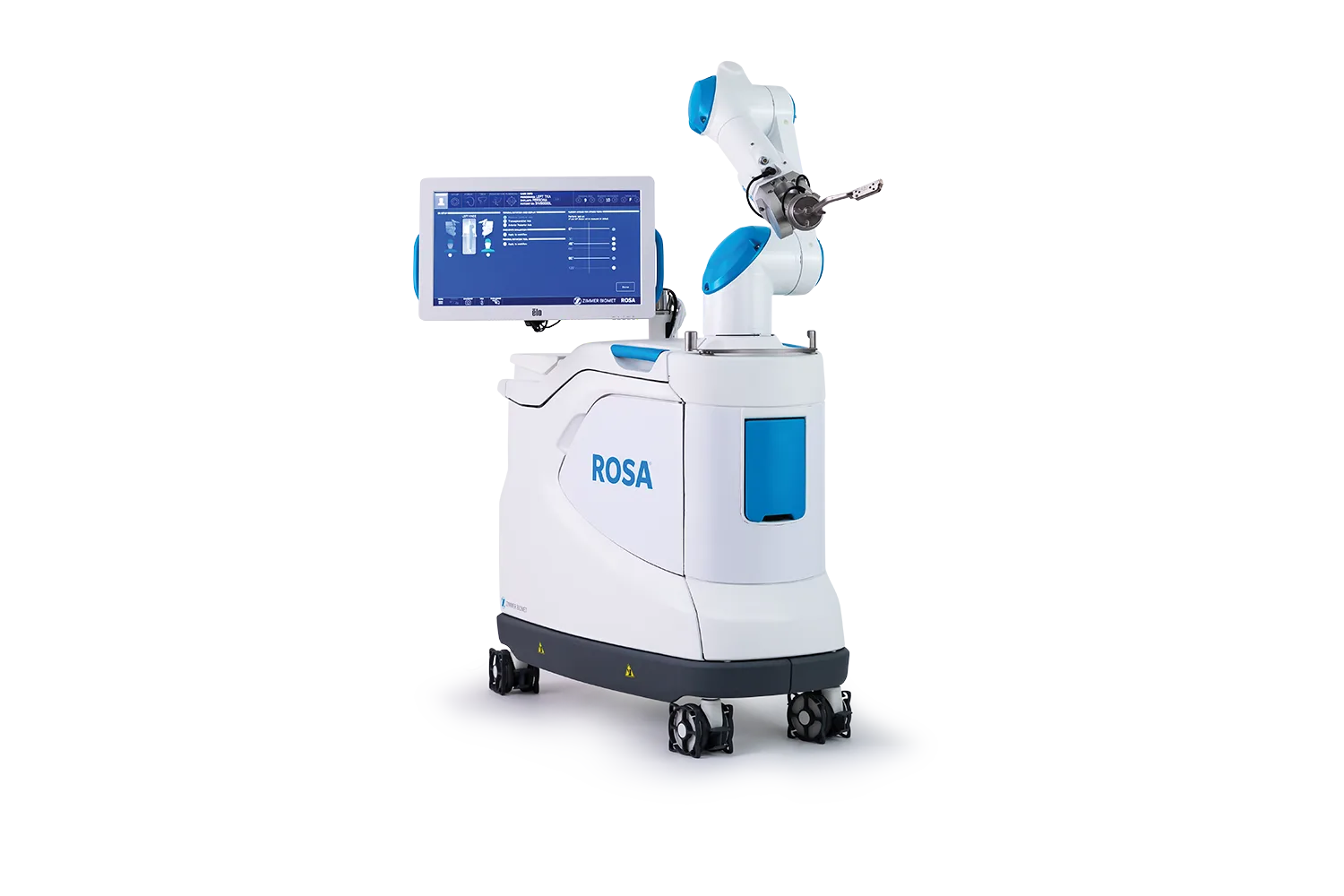
What ROSA actually is
ROSA stands for Robotic Surgical Assistant — Zimmer Biomet's surgical robot for knee and hip replacement. The name is honest: it assists. ROSA doesn't move a blade on its own and it can't perform any part of your operation without Dr. Morton's hands on the instruments. What it contributes is measurement and consistency at a level human eyes and mechanical jigs can't match: it tracks your bones in real time through optical cameras, positions cutting guides to fractions of a degree, and verifies every step against the plan before the next one happens.
Dr. Morton has used ROSA to reshape what's possible in Hawai‘i — the state's first robotic-assisted total hip replacement and the first Persona IQ® smart knee in Hawai‘i were both ROSA cases.
ROSA Knee: how a robotic knee replacement actually goes
The sequence matters, so here it is step by step:
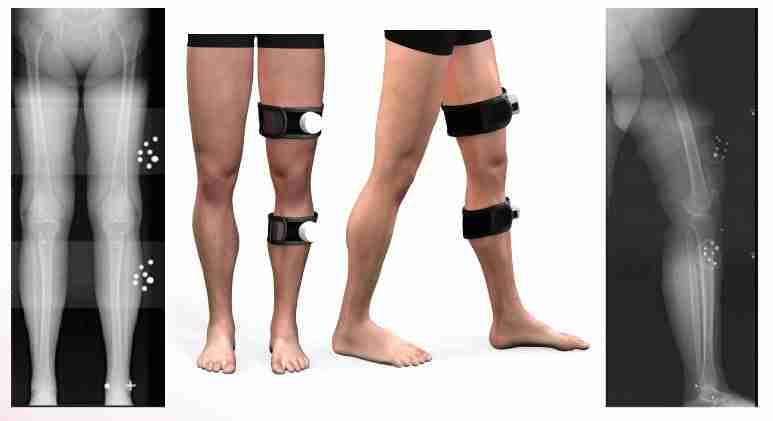
- Planning without a CT scan. ROSA builds its 3D understanding of your knee from standard X-rays — or from no pre-op imaging at all, mapping the bone surfaces directly in the operating room. That means no extra CT appointment and no added CT radiation.
- Registration. After the knee is exposed, Dr. Morton touches key landmarks with a tracked pointer while cameras watch reference arrays on your bone. In about two minutes the robot knows your knee's exact geometry — including how your ligaments behave as it moves.
- Live soft-tissue balancing — ROSA's signature. A knee replacement fails patients most often not because the implant was the wrong size, but because the ligament tension around it was wrong. ROSA measures your gaps in extension and flexion before any cut is made, in millimeters, and shows how each planned adjustment changes the balance. Dr. Morton tunes the plan to your ligaments — rather than cutting first and discovering the balance later.
- Guided cuts, human hands. The robotic arm positions the cutting guide at the planned angle and holds it rock-steady; Dr. Morton makes each cut and verifies it against the plan to within a fraction of a millimeter and a degree.
- Trial, verify, implant. The robot re-checks alignment and balance with trial components in place. Only when the measured knee matches the planned knee does the final implant go in — most often a cementless biologically-fixed knee or the Persona IQ smart knee.
All of it happens through Dr. Morton's muscle-sparing subvastus approach, without a tourniquet, under opioid-sparing anesthesia — the robot complements the technique, it doesn't replace it.
ROSA Hip: precision for the anterior approach
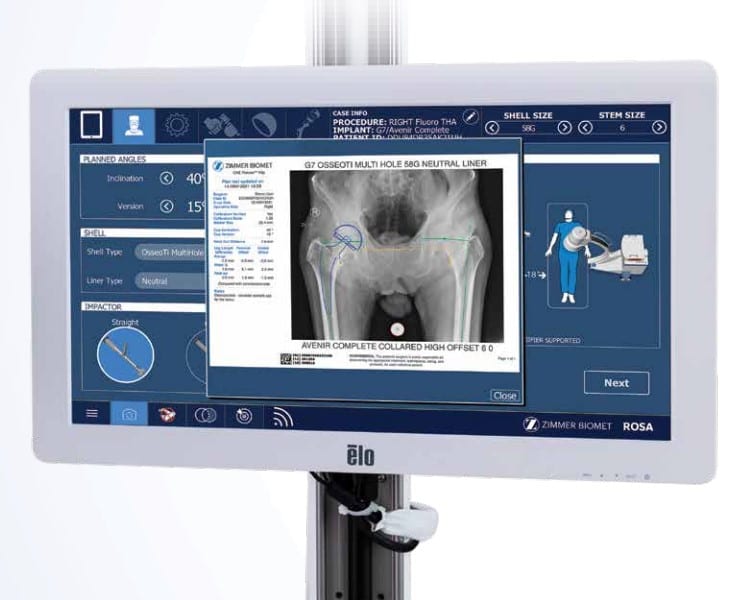
For total hip replacement, ROSA works with live fluoroscopic imaging during Dr. Morton's anterior (bikini-incision) approach. The two measurements that decide how a hip replacement feels for the next twenty years — cup position and leg length — are exactly where robotic verification earns its keep:
- Cup orientation is checked against the plan in real time rather than eyeballed — cup position is what keeps a hip stable and wearing evenly for decades.
- Leg length and offset are measured digitally against your other side during surgery, so your legs feel even afterward — one of the first things patients check.
This is the ROSA route to a robotic hip — the one Dr. Morton introduced to Hawai‘i in 2022. On Hawai‘i Island his robotic hips are performed on Mako at Hilo Community Surgery Center, planned from a CT scan of your own pelvis and hip. See the robotic hip program for how a robotic hip is planned and performed today.
What the evidence says
Across published studies, robotic assistance in knee and hip replacement is consistently associated with more accurate implant positioning and fewer alignment outliers than conventional instrumentation, along with less inadvertent soft-tissue injury and, in a number of series, less early pain and faster initial recovery. Long-term survivorship data keep accumulating — joint replacements are built to last decades — and the mechanism is common sense: implants positioned closer to plan, in a knee balanced in millimeters rather than by feel, start life with fewer reasons to fail.
"His knowledge and skill in robotic hip and knee replacement surgery has given me back my life." — Verified patient, Yelp review
ROSA, MAKO, CORI, VELYS — why platform fluency matters
ROSA is one of four major robotic platforms, and Dr. Morton is certified on all of them — ROSA®, MAKO, CORI, and VELYS. Each takes a different route to the same goal: MAKO plans from a CT scan and enforces the plan with a haptic boundary; ROSA plans from X-rays and shines at live ligament balancing; CORI and VELYS are compact imageless systems. Because he isn't locked to one vendor, the robot and implant are chosen for your anatomy, your bone quality, and your surgical venue — at The Queen's Medical Center or Adventist Health Castle on O‘ahu, or at Hilo Community Surgery Center on the Big Island, where hip and knee replacements are Mako cases. The full landscape is covered in the technology guide.
What stays in the surgeon's hands
Worth saying plainly: the robot executes a plan, and the plan is the surgery. Sizing your implant, deciding what your ligaments need, handling the unexpected, protecting muscle on the way in and out: that's Dr. Morton, fellowship-trained in adult hip and knee reconstruction, with the robot serving as the most precise instrument in the room. Robotic assistance also doesn't change your bill — it's how the operation is performed, not an upgrade you're charged for.
Medically reviewed by Paul N. Morton, MD, FAAOS, FAAHKS — board-certified orthopedic surgeon, fellowship-trained in adult hip & knee reconstruction and orthopedic trauma. Last reviewed: .
This page is for education only and isn’t a substitute for an exam and personalized advice — schedule a consultation to discuss your situation.