
 English
 日本語
日本語 한국어
한국어 中文(廣東話)
 Tagalog
 ไทย
ไทย Tiếng Việt
 Chuukese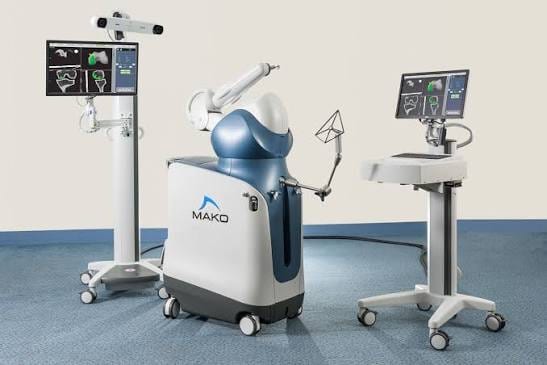
What Mako actually is
Mako SmartRobotics™ is Stryker's robotic-arm-assisted surgery platform, and it approaches precision differently than any other system: it starts with a CT scan of your joint, builds a millimeter-accurate 3D model of your anatomy, and lets Dr. Morton perform the entire operation virtually — sizing, positioning, alignment — before you ever enter the operating room. During surgery, the robotic arm then holds him to that plan with haptic boundaries: physical resistance that stops the saw or reamer at the edge of the planned resection, protecting the bone and soft tissue beyond it.
It's one of the most widely used surgical robots in the world, with well over a million procedures performed globally — and one of the four platforms Dr. Morton is certified on, alongside ROSA®, CORI, and VELYS.
On Hawai‘i Island, Mako is the platform: Dr. Morton performs Mako robotic hip replacement — and Mako knee replacement — at Hilo Community Surgery Center, so Big Island patients get CT-planned, haptic-guided joint replacement close to home.
Step one happens before surgery: the CT plan
Mako's defining feature is that your operation is designed in advance from your own imaging:
- CT scan. A quick, painless CT of your pelvis and hip — or of your knee — produces the raw data. No IV contrast and no special preparation. It uses a low dose of X-ray radiation, and what you get back is a bone map accurate to the millimeter.
- Your joint in 3D. Software reconstructs your anatomy — bone shape, bone quality landmarks, deformity from arthritis — into a model Dr. Morton can rotate, measure, and operate on virtually.
- The personalized plan. Implant size, position, rotation, and alignment are set to your anatomy before incision. For hips, that means cup size and position — inclination and anteversion — plus stem size, leg length, and offset planned to your own pelvis; for knees, component rotation and joint line planned to your bone — not to a population average.
On surgery day the plan isn't a suggestion — it's the operating envelope. And it stays adjustable: if your anatomy calls for a change once Dr. Morton is looking at the joint itself, the plan is updated on the screen and the arm holds the new one.
In the operating room: haptic boundaries
In the operating room your anatomy is registered to the plan: tracking arrays held by small pins let the camera follow your bones in real time, and the pins come out at the end of the case. From there the robotic arm works with Dr. Morton, not instead of him:
- He guides the instrument; the arm holds the boundary. In a hip, reaming and cup impaction are kept inside the planned boundary; in a knee, the saw is held at the edge of the planned resection — Stryker calls this AccuStop™ haptic technology. Ligaments, tendons, and healthy bone outside the plan are protected by hardware, not just by care.
- Leg length and offset, live. In a hip replacement the screen reads out leg length and offset against the plan while the trial components are in — two of the details patients notice most, confirmed before the incision is closed.
- Balance is checked before cuts are final. In knees, the plan is fine-tuned intraoperatively against how your ligaments actually tension through motion, so the implant is balanced to your soft tissue.
- Every step is verified. Cut surfaces and component positions are checked against the CT plan in real time, then confirmed before the final implant is seated.
"I was walking with a walker and doing light PT exercises the same day after my hip replacement!" — Verified patient, Yelp review
Where Mako especially shines: partial knees
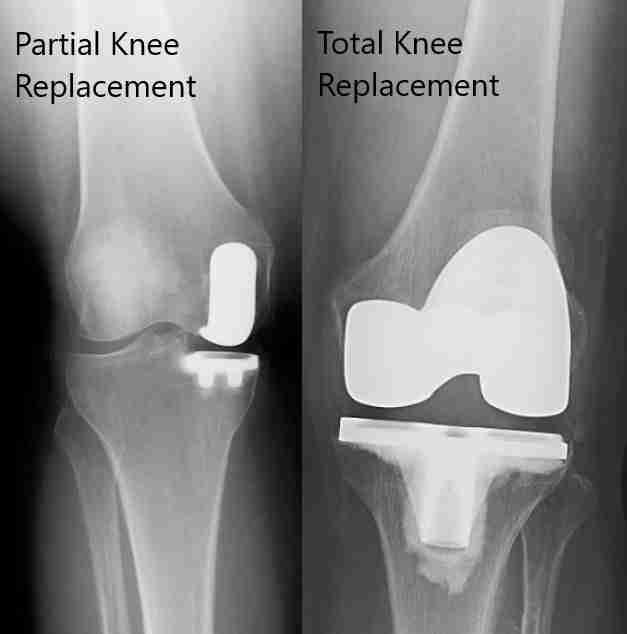
Mako began life as "MAKOplasty" — a robotic system for partial (unicompartmental) knee replacement, and it remains the reference standard for that operation. A partial knee replaces only the worn compartment and keeps your ACL, PCL, and the rest of your knee — but its margin for error is smaller than a total knee's, which is exactly where CT-level planning and haptic boundaries earn their keep. If you're a partial-knee candidate — isolated single-compartment arthritis with intact ligaments — robotic assistance materially improves how reliably the implant goes in where it should.
Mako vs ROSA: how the two platforms differ
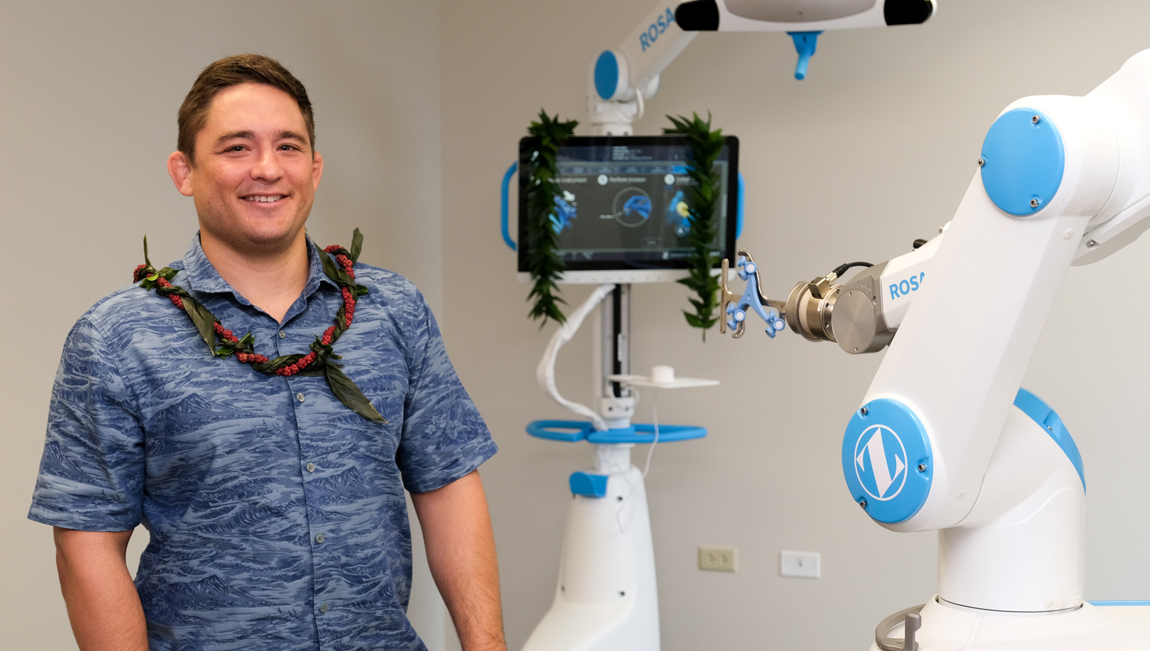
Patients ask which robot is "best." Both are excellent, they take different routes to the same destination, and Dr. Morton is fluent in each.
- Planning: Mako plans from a pre-op CT scan, which gives the most detailed 3D picture of your own anatomy, for one extra appointment and a low dose of radiation. ROSA plans from standard X-rays or maps the bone live in the OR.
- Control philosophy: Mako's arm enforces haptic boundaries — it holds the instrument inside the plan. ROSA positions and steadies the cutting guides while the surgeon cuts, with continuous measurement throughout.
- Implant pairing: Mako pairs with Stryker implant systems; ROSA pairs with Zimmer Biomet's Persona® family, including the Persona IQ® smart knee.
- Both are surgeon-driven, both are associated with more accurate component placement than conventional instrumentation, and both support same-day outpatient joint replacement.
Because Dr. Morton is certified across ROSA, Mako, CORI, and VELYS, the choice follows your anatomy, the implant that fits your case, and your surgical venue — on Hawai‘i Island, that means Mako hip and knee replacement at Hilo Community Surgery Center. That fluency is rarer than it sounds: most surgeons are fluent in exactly one robot.
What the evidence says
The published record on Mako mirrors robotic-assisted surgery generally: component positioning lands closer to plan with fewer outliers than manual instrumentation, haptic-bounded cutting reduces inadvertent soft-tissue injury, and several series report less early pain, less opioid use, and shorter length of stay. Long-term survivorship data keep accumulating as these implants outlive the studies that follow them — and what is already well understood is that a replacement which starts in its planned position, in balanced soft tissue, is the best way to stack the odds for the decades after.
What it means for your surgery with Dr. Morton
Robotics is a tool inside a larger philosophy — muscle-sparing approaches, tourniquet-free technique, opioid-sparing anesthesia, cementless fixation where bone quality allows, and same-day mobilization. Whichever platform your case calls for, the robot's job is identical: make the plan precise and the execution match the plan. And it doesn't change your bill — robotic assistance is how the operation is performed, not an upcharge.
Medically reviewed by Paul N. Morton, MD, FAAOS, FAAHKS — board-certified orthopedic surgeon, fellowship-trained in adult hip & knee reconstruction and orthopedic trauma. Last reviewed: .
This page is for education only and isn’t a substitute for an exam and personalized advice — schedule a consultation to discuss your situation.