
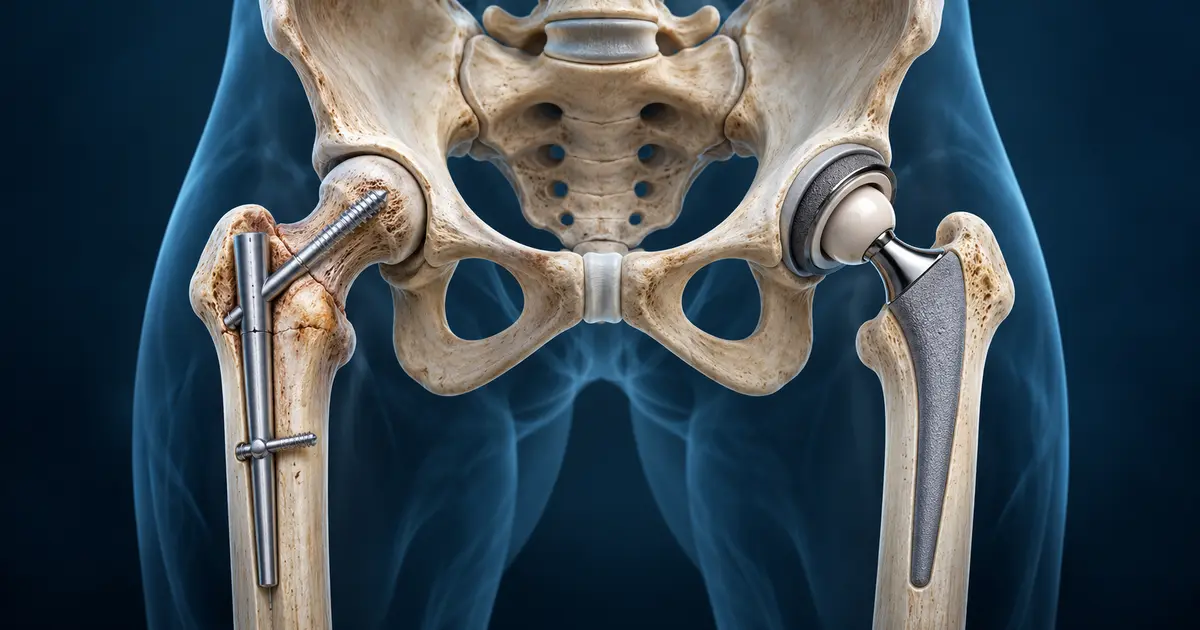
The short answer: prior hardware changes the plan, not necessarily the goal
Hip replacement after earlier fracture fixation is often called conversion total hip arthroplasty. The goal is still to replace a damaged ball-and-socket joint, relieve pain, and improve function. What changes is the work required to reach that goal.
The surgeon may need to remove screws, a plate, a sliding hip screw, or a cephalomedullary nail; manage old screw holes and bone loss; correct deformity; and choose an implant that gains secure fixation beyond weakened bone. Some cases resemble a complex primary hip replacement, while others require revision-style implants and techniques.
Why a previously repaired hip may later need replacement
Fracture fixation is designed to preserve the natural hip while bone heals. Replacement may be considered later when the fracture does not heal, heals in a poor position, the femoral head loses its blood supply and collapses, hardware cuts out or breaks, or post-traumatic arthritis damages the joint.
Pain alone does not prove that the hardware or joint has failed. Pain may also come from the spine, tendons, bursae, infection, or another source. The evaluation begins by identifying the diagnosis rather than assuming that every painful repaired hip needs replacement.
Conversion hip replacement is different from routine primary hip replacement
A routine primary hip replacement for osteoarthritis starts with an unoperated hip and relatively predictable anatomy. Prior fracture surgery can leave scar tissue, altered landmarks, muscle injury, deformity, and holes where screws once passed through bone. Hardware removal may lengthen the procedure and increase blood loss.
Published studies consistently describe conversion hip replacement as a higher-complexity operation with greater risks than uncomplicated primary hip replacement, including infection, fracture, dislocation, transfusion, and reoperation. Those are population-level findings, not a prediction for one person. Risk depends on the original fracture, hardware, bone quality, health conditions, surgical plan, and rehabilitation.
The original operative report can change the entire plan
Bring the operative report from the fracture surgery when possible. It can identify the manufacturer, model, sizes, and insertion technique for the hardware. That information helps the team obtain compatible extraction tools before surgery.
If the report is unavailable, prior X-rays, implant cards, and records from the hospital or surgeon are still useful. Modern imaging often identifies the general hardware type, but exact records reduce surprises. Do not delay an evaluation simply because old records are difficult to find; the office can explain what is most important.
- The operative report and implant log from the original fracture surgery
- Current and older X-rays, CT scans, or MRI reports
- A timeline of pain, falls, wound problems, and prior treatments
- Any history of drainage, fever, infection, or antibiotics related to the hip
- A current medication list, including blood thinners and osteoporosis treatment
- Information about walking aids, leg-length change, and current function
Imaging maps the hardware, deformity, and remaining bone
Standing pelvis and hip X-rays show joint damage, fracture healing, hardware position, leg length, alignment, and bone quality. Full-length or additional femur views may be needed when a long nail or plate extends well below the hip. A CT scan can clarify rotational deformity, nonunion, acetabular damage, and bone defects when plain films do not tell the whole story.
The images also help decide whether a standard hip stem can obtain secure fixation or whether a longer, modular, or revision-style stem must bypass old screw holes or weak bone. The plan is made around the individual anatomy rather than a default implant.
Infection must be considered before conversion
A prior fracture operation creates a separate infection history. Infection may be obvious, with drainage or repeated wound problems, or subtle, presenting only as pain or failure of fixation. The surgeon may order inflammatory blood tests and, when concern remains, aspiration or other testing before replacement.
Starting leftover antibiotics can alter test results. Unless another clinician has identified an urgent infection requiring treatment, contact the orthopedic team before taking antibiotics for unexplained hip symptoms.
Does all hardware have to come out?
Hardware that blocks implant placement, is loose or broken, contributes to pain, or interferes with correction usually needs removal. Some hardware that does not interfere with the reconstruction may be retained when removal would create unnecessary bone damage. The answer depends on its location, stability, material, and relationship to the planned hip components.
Removal and hip replacement may occur during one operation or in stages. Staging can be appropriate when infection is suspected, soft tissues need time to recover, removal is unusually extensive, or the diagnosis remains uncertain. It is not automatically safer for every patient. Recent comparative evidence does not support a blanket rule that elective staged removal always lowers infection risk.
Old screw holes can temporarily weaken the femur
Removing screws or a nail leaves stress risers—areas where load is concentrated in weaker bone. The surgeon may choose a stem that bypasses those holes, add cables or other protection, and modify weight-bearing after surgery. Severe deformity or bone loss can require an osteotomy or a modular revision implant.
This is one reason operative planning and implant availability matter. The team prepares for the expected reconstruction and also for safe alternatives if the bone or hardware differs from the preoperative images.
The surgical approach is individualized
Prior surgery does not automatically rule out an anterior approach, and no approach is best for every conversion. Hardware location, old incisions, scar tissue, deformity, body habitus, soft-tissue condition, and the need for femoral exposure all matter.
A surgeon may use an anterior, lateral, or posterior route, extend an incision, or use a separate incision for hardware removal. The safest exposure is the one that allows controlled removal, reliable implant fixation, fracture prevention, and restoration of stability. Read the JRH anterior hip replacement guide for the usual primary-hip approach and its limitations.
Implant choices may look more like revision surgery
A standard cementless stem may be suitable when proximal bone remains strong and old holes do not compromise fixation. Other hips need a longer or modular stem that anchors farther down the femur. Cemented fixation may be considered in selected patients based on bone quality, anatomy, and fracture risk.
On the socket side, the surgeon evaluates arthritis, prior acetabular injury, bone loss, and stability. Larger heads or dual-mobility bearings may be considered when dislocation risk is elevated. These choices are tools, not guarantees, and are tailored to the reconstruction.
Preparation includes bone health and medical risk
Many people needing conversion surgery have osteoporosis, a history of fracture, anemia, or other conditions that affect healing and transfusion risk. The plan may include bone-health evaluation, medication review, nutrition, smoking cessation, diabetes control, and correction of anemia when appropriate.
Do not start or stop osteoporosis medicine, blood thinners, supplements, or pain medicine based on a general article. Coordinate changes with the treating clinicians. The JRH guide to osteoporosis before joint replacement explains why bone quality matters around implants.
Recovery may be less predictable than after a routine hip replacement
Some patients can bear weight and follow a familiar rapid-recovery pathway. Others need a walker longer or temporary weight-bearing restrictions because of a nonunion, fracture risk, osteotomy, bone graft, or revision-style fixation. Physical therapy is matched to the reconstruction.
Hospital stay, return to driving, and return to work vary more widely than after uncomplicated primary hip replacement. Ask for instructions based on the actual operation rather than comparing recovery with a friend who had routine arthritis surgery.
Questions to ask at the consultation
A focused discussion can make a complex plan easier to understand:
- What is the most likely source of my pain or fixation failure?
- Do you need the original operative report or implant-removal tools?
- Will all hardware need removal, and is one-stage or staged treatment more likely?
- How will infection be evaluated before surgery?
- What type of stem or socket reconstruction may be needed?
- How will old screw holes or weak bone be protected?
- Which surgical approach best fits my hardware and anatomy?
- Will I have weight-bearing restrictions or a longer rehabilitation?
- What findings could change the plan during surgery?
- Where should a complex conversion procedure be performed?
When to seek urgent assessment
Seek prompt evaluation for sudden inability to bear weight, a new deformity, rapidly worsening pain after a fall, drainage, spreading redness, fever with hip symptoms, or a wound opening over hardware. Call 911 for chest pain, severe shortness of breath, fainting, or stroke symptoms.
If pain is gradually increasing without emergency signs, schedule a structured review rather than waiting for the hardware to fail catastrophically. Earlier diagnosis can preserve bone and simplify treatment.
The bottom line
Hip replacement after prior fracture fixation is possible, but it deserves a conversion-specific plan. The most important steps are identifying why the hip hurts, finding the original implant details, mapping bone and deformity, screening for infection, and preparing the right extraction and reconstruction options.
Bring your operative report and imaging to an orthopedic consultation, or start with a records-and-imaging review if travel is difficult. Dr. Paul Morton’s adult-reconstruction and trauma training supports evaluation of complex hips across Hawai‘i. Individual recommendations and outcomes vary.
Sources and further reading
- Outcomes of conversion total hip arthroplasty following previous hip fracture surgery
- Systematic review: conversion THA after internal fixation of proximal femur fractures
- Total hip arthroplasty after proximal femoral nailing: preparation and surgical considerations
- Matched analysis of concurrent versus staged hardware removal during conversion THA
- AAOS plain-language summary: management of hip fractures in older adults
Medically reviewed by Paul Norio Morton, MD, FAAOS, FAAHKS. Last reviewed: . This article is for education only and isn’t a substitute for an exam and personalized advice — schedule a consultation to discuss your situation.