
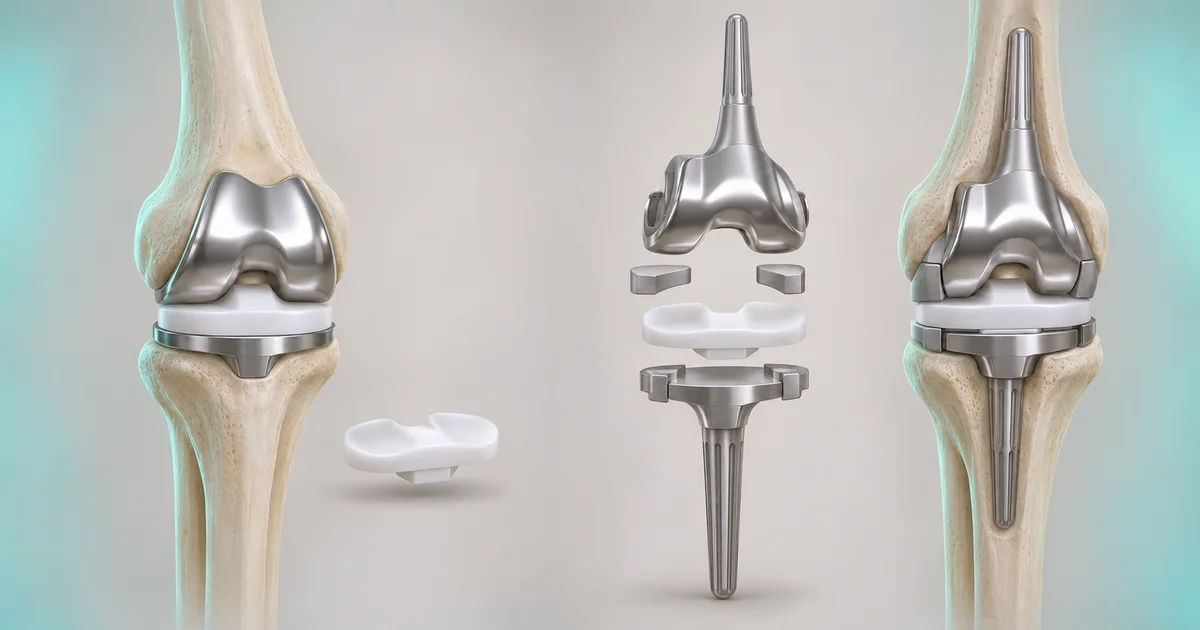
What does “just replacing the plastic” mean?
Most modern total knee replacements have a metal femoral component, a metal tibial tray, and a medical-grade polyethylene insert between them. In an isolated polyethylene insert exchange, the surgeon opens the knee, removes the modular plastic insert, and places a new compatible insert while retaining the metal components.
This is still revision surgery. The joint must be exposed, tissue and implant stability must be assessed, and infection must be considered. A liner exchange is different from a routine office procedure, and it is not automatically the least risky answer for every painful, swollen, stiff, or unstable knee replacement.
When might a liner exchange be considered?
A liner-only strategy may be considered in a carefully selected knee when the metal components are well fixed, well aligned, appropriately rotated, compatible with an available insert, and supported by usable ligaments. The failure mechanism must also be one that a new insert can reasonably address. Examples may include selected patterns of instability or polyethylene wear. In some acute infection operations, surgeons may exchange the modular insert as part of a separate debridement strategy; that is a different decision with its own timing and candidacy rules.
Selection matters. A large retrospective series reported favorable survivorship when insert exchange was used for instability or wear in knees with well-fixed, well-aligned components. Other studies have found less durable control of instability than full component revision, underscoring that a successful smaller operation depends on the right diagnosis and anatomy rather than the insert alone.
When are metal components more likely to need revision?
Component revision is more likely when an implant is loose, malpositioned, poorly rotated, damaged, incompatible with the needed insert, or unable to provide adequate stability. It may also be necessary when there is substantial bone loss, a fracture around the implant, severe stiffness related to component position, chronic infection, or ligament deficiency that requires a more constrained implant.
Sometimes only one metal component needs replacement; other times the femoral and tibial components—and occasionally the patellar component—must be revised. The American Academy of Orthopaedic Surgeons explains that revision can range from replacing one part to removing all components and rebuilding missing bone with augments, graft, or specialized stems. “Partial” and “full” are therefore useful shorthand, but they do not capture every surgical plan.
Why can’t a thicker liner fix every loose-feeling knee?
A thicker or more conforming insert changes the space and constraint inside the joint, but it cannot correct every cause of instability. If component position, joint-line height, ligament balance, or flexion-extension gaps are wrong, simply adding thickness can leave the knee unstable in part of its motion or make it too tight elsewhere. It also cannot reliably solve pain caused by infection, loosening, fracture, nerve problems, or pain referred from the hip or spine.
Published results reflect that complexity. A 2024 comparative study found isolated exchange less reliable and durable than full component revision for postoperative instability and recommended reserving it for knees with competent collateral ligaments and optimized component position, offset, and rotation. Another selected-patient study found similar two-year rerevision frequencies but emphasized the role of implant constraint. These retrospective studies do not provide a universal rule for one patient.
What workup helps decide between the two?
The decision begins with the history and physical examination: when symptoms started, whether the knee gives way, where it hurts, how it moves, whether swelling is recurrent, and whether the ligaments feel stable through the full arc. Weight-bearing X-rays can assess fixation, alignment, joint line, bone loss, and obvious wear. Prior operative reports and implant stickers are valuable because liner compatibility depends on the exact implant system.
If infection is possible, blood tests and often joint aspiration may be needed before choosing a revision strategy. CT or other studies may help answer targeted questions about component rotation, bone loss, or an occult fracture. No single image or symptom decides the operation. The broader knee instability guide explains why a loose feeling needs a diagnosis, and the infected knee replacement guide describes why infection changes the treatment pathway.
Can the surgical plan change during the operation?
Yes. Even after careful testing, the final decision may depend on what the surgeon finds after the knee is exposed. A component that appeared fixed may move during direct testing. Ligament balance may remain unacceptable after trial inserts. Previously unrecognized wear, corrosion, tissue damage, or implant incompatibility may make a larger reconstruction safer.
Before surgery, ask whether the consent and implant plan allow for both a limited exchange and component revision, what findings would trigger the larger procedure, and what bone-reconstruction or constrained implants might be available. This contingency planning is not indecision; it is part of revision surgery when the diagnosis has more than one plausible intraoperative endpoint.
Is recovery always easier after a liner exchange?
A liner exchange may preserve bone and avoid removing well-fixed metal components, and some patients have a shorter operation or hospital stay. But recovery still varies with the indication, tissue work, infection status, preoperative strength, complications, and rehabilitation needs. A smaller implant change does not guarantee less pain, faster recovery, or a better long-term result.
Full component revision is generally more complex because removing implants can sacrifice bone and may require stems, cones, sleeves, augments, or graft. The tradeoff is that it lets the surgeon correct problems a liner cannot fix. For a broader recovery framework, see recovery after revision joint replacement.
Questions to ask at a revision consultation
- What is the leading cause of failure, and what competing diagnoses still need to be excluded?
- Are the femoral and tibial components well fixed, well aligned, and correctly rotated?
- Are the collateral ligaments and extensor mechanism functioning?
- Has infection been evaluated appropriately?
- Is a compatible insert available, and would changing thickness or constraint address the actual problem?
- What findings would make you revise one or both metal components?
- How would bone loss or an unexpected fracture be managed?
A useful consultation produces a diagnosis-based plan with explicit contingencies. The goal is not the smallest operation at any cost; it is the most appropriate reconstruction for the failure pattern.
The bottom line
Replacing only the polyethylene insert can be reasonable in selected knee replacements with well-fixed, well-positioned components, usable ligaments, a compatible implant system, and a problem the new insert can actually correct. Loosening, malposition, major ligament deficiency, infection, fracture, bone loss, or severe imbalance often requires component revision or a different strategy. If a knee replacement is painful, swollen, stiff, or unstable, schedule a revision-focused orthopedic evaluation rather than assuming that a thicker plastic liner will solve it.
Sources and further reading
- AAOS OrthoInfo: Revision Total Knee Replacement
- Isolated polyethylene exchange versus full component revision for instability (2024)
- Isolated tibial polyethylene insert exchange for instability or wear (2023)
- Constraint in revision knee replacement: component revision versus insert exchange (2023)
- Review: The role of isolated polyethylene exchange in total knee arthroplasty (2017)
Medically reviewed by Paul Norio Morton, MD, FAAOS, FAAHKS. Last reviewed: . This article is for education only and isn’t a substitute for an exam and personalized advice — schedule a consultation to discuss your situation.