
The short answer: noise is common, but the company it keeps matters
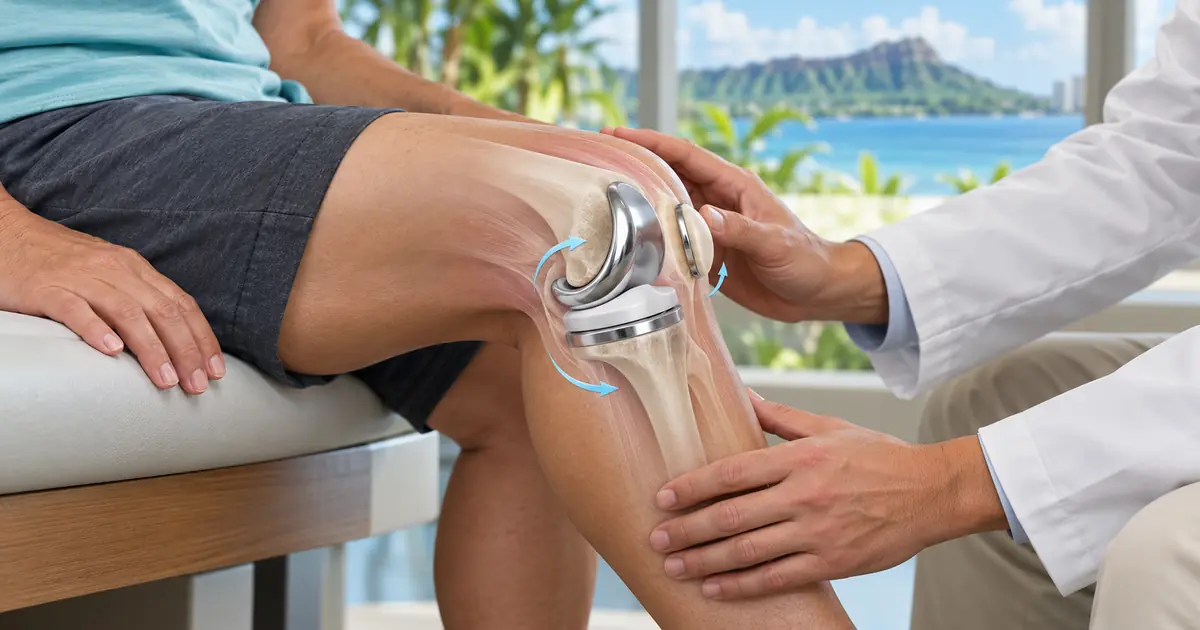
A knee replacement does not reproduce the silent cartilage-on-cartilage motion of a young natural knee. Its shaped metal surfaces, polyethylene bearing, kneecap, ligaments, tendons, and scar tissue all interact as the knee bends and straightens. A soft click during a step, squat, or transfer can therefore be a normal mechanical sensation.
In a five-center survey, 27% of people with a knee arthroplasty reported grinding, popping, or clicking during the previous month. Noise was more common after total than partial replacement. That study also found more residual symptoms among people who noticed noise, so the right conclusion is not “all noise is harmless.” It is that noise is common and should be interpreted alongside pain, swelling, stability, motion, and change over time.
Why a replaced knee can sound or feel different
The implant has deliberate geometry that guides motion. Depending on the design, a post-and-cam mechanism may engage as the knee bends, the polyethylene insert may allow small controlled movements, and the kneecap tracks along the front of the femoral component. Those contacts can be audible or palpable without indicating wear or failure.
Early after surgery, swelling can alter how the kneecap and tendons move. Muscles are still rebuilding control, and tissues that were tight or deformed before surgery are adapting to a new alignment. As swelling settles and strength returns, many patients notice the sound less even if the implant itself has not changed.
Patterns that are often reassuring
No online checklist can diagnose an implant, but several features generally make a click less concerning. The noise is intermittent, painless, and linked to a repeatable movement such as rising from a chair. The knee is not buckling or locking. Motion and walking tolerance are improving or stable. There is no new swelling, warmth, redness, drainage, or fever.
Reassuring does not mean you must ignore a concern. Mention the pattern at routine follow-up, especially if it is frequent or bothersome. A 2024 study found that reported noise symptoms, joint awareness, and function improved with greater time after total knee replacement, supporting patience when recovery is otherwise on track.
Click, pop, grind, and clunk are descriptions—not diagnoses
People use the same word for very different sensations. A light click may be implant contact. A pop can come from a tendon moving over a bony prominence or from scar tissue shifting. A grinding sensation may reflect the kneecap and surrounding soft tissues, but it can also be used to describe stiffness or swelling. A clunk may be a benign engagement of the implant—or a specific painful catch that needs examination.
Rather than trying to name the mechanism yourself, record what movement produces it, whether you can feel it under the kneecap or deeper in the joint, and whether pain, swelling, or giving way follows. That pattern gives the surgeon far more useful information than the sound word alone.
What patellar clunk syndrome actually means
Patellar clunk syndrome is not a general term for any noisy replacement. It is a distinct problem most associated with certain posterior-stabilized total knee designs. A small fibrous nodule can form near the lower quadriceps tendon above the kneecap. As the knee moves from a bent position toward straight, that tissue may catch near the front of the femoral component and then release with a palpable, often painful clunk.
A systematic review describes this scar-tissue mechanism and notes that implant design, component position, patellar height, and surgical factors can influence risk. The diagnosis requires the characteristic motion and examination; a random painless click is not patellar clunk. Mild symptoms may be observed, while persistent painful catching may lead to targeted treatment after the cause is confirmed.
When noise may signal instability instead
Noise plus a sense that the knee shifts, wobbles, buckles, or cannot be trusted deserves a different workup. Instability can occur in extension, flexion, mid-flexion, or more than one direction. The metal components may still be firmly fixed while the soft-tissue balance is not providing stable support.
Difficulty going down stairs, repeated swelling after activity, needing to lock the knee straight, or a recurrent clunk paired with giving way is more important than the loudness of the sound. Review the focused guide to a knee replacement that feels loose or unstable, and arrange an examination rather than trying to strengthen through repeated buckling.
Red flags that should not wait for a routine visit
Contact the surgical team promptly for a new or worsening noise accompanied by increasing pain, recurrent swelling, loss of motion, locking, or a sudden decline in walking. Seek urgent assessment after a fall or injury if the knee changes shape, you cannot bear weight, or pain and swelling escalate quickly.
- Persistent or increasing pain with the sound
- New giving way, locking, or inability to fully move the knee
- Rapid or recurrent swelling, especially after a specific event
- Increasing warmth or redness, wound drainage, fever, chills, or sweats
- A sudden new clunk after a fall, twist, or direct blow
- A sound that begins months or years after a previously quiet, well-functioning knee
- Progressive loss of function or a new limp
Why warmth, drainage, or fever changes the decision
Infection around a knee replacement can present with persistent pain, swelling, warmth, redness, or drainage, with or without fever, chills, or sweats. The American Association of Hip and Knee Surgeons advises that any meaningful change in replacement function should prompt contact with the surgeon. Noise alone is not a typical infection diagnosis, but noise plus these symptoms should not be watched at home.
Do not start leftover antibiotics before speaking with the treating team unless another clinician has directed you. Antibiotics can alter test results, and a suspected joint infection needs a coordinated evaluation rather than an improvised course of medication.
What the evaluation usually includes
The workup begins with timing. Was the noise present from early recovery, or did it appear after months of quiet function? Is it painless and repeatable, or unpredictable and painful? Did it follow a fall? Does swelling develop later that day? The surgeon then examines gait, motion, kneecap tracking, ligament stability, strength, tenderness, and whether the sound can be reproduced.
Standing X-rays can show component position, alignment, fractures, bone changes, and signs that may suggest loosening or wear. Comparison with prior films is often more useful than one image. If infection is a concern, blood tests and sometimes joint-fluid analysis may be needed. Advanced imaging is reserved for questions that examination and standard radiographs do not answer.
What you can do while arranging nonurgent follow-up
If the knee is painless, stable, and improving, keep following the prescribed recovery plan. Build quadriceps and hip strength with approved exercises, control swelling after activity, and use a walker or cane until your gait is steady. Avoid repeatedly forcing the knee into the exact movement that produces a dramatic clunk just to test it.
Make a short phone video only if the sound and motion occur naturally and can be recorded safely. Note the activity, angle of bend, pain level, swelling, and whether the sensation is becoming more or less frequent. This record can help when an intermittent symptom is absent in the clinic.
Treatment depends on the cause—not the volume
Painless mechanical noise often needs reassurance and time, not a procedure. Swelling control, strength, and gait training can reduce joint awareness during recovery. A tendon or kneecap tracking problem may improve with focused rehabilitation when the components are well positioned and the knee is stable.
Persistent painful patellar clunk may be treated by removing the responsible scar tissue after the diagnosis is confirmed. Instability, infection, loosening, fracture, or major component-position problems require their own treatment pathways. Revision is not justified by sound alone; it should address a clearly identified mechanism with a realistic chance of improving pain and function.
Questions to bring to the appointment
A focused visit is easier when you describe the pattern rather than asking only whether the noise is “normal.” Useful questions include:
- Can you reproduce the click or clunk during the examination?
- Does the kneecap track normally through the full range of motion?
- Is the knee stable in extension, mid-flexion, and deeper flexion?
- Do current X-rays differ from my earlier postoperative films?
- Could swelling, weakness, scar tissue, or implant design explain the sensation?
- Are infection tests needed based on my symptoms?
- Would physical therapy help, and which movements should I avoid for now?
- What change should trigger an urgent call rather than routine follow-up?
The bottom line
Clicking after knee replacement is common because the reconstructed joint contains engineered surfaces and healing soft tissues, not silent native cartilage. An occasional painless click in a stable, steadily improving knee is usually an expectation to discuss, not an emergency.
The decision changes when noise is painful, newly progressive, paired with swelling or giving way, associated with locking or lost motion, or accompanied by infection signs. Dr. Paul Morton evaluates the pattern, examination, and serial imaging before recommending treatment. To have a replaced knee assessed, schedule an orthopedic consultation or call (808) 439-6201.
Sources and further reading
- Clinical Orthopaedics and Related Research: Frequency of noise after modern knee arthroplasty and associated symptoms
- Journal of Arthroplasty: Noise symptoms, joint awareness, and function over time after total knee replacement
- World Journal of Orthopedics: Systematic review of patellar clunk syndrome
- AAHKS: Infection and your joint replacement
- AAHKS: Follow-up care after knee replacement
Medically reviewed by Paul Norio Morton, MD, FAAOS, FAAHKS. Last reviewed: . This article is for education only and isn’t a substitute for an exam and personalized advice — schedule a consultation to discuss your situation.