
What does a dislocated hip replacement mean?
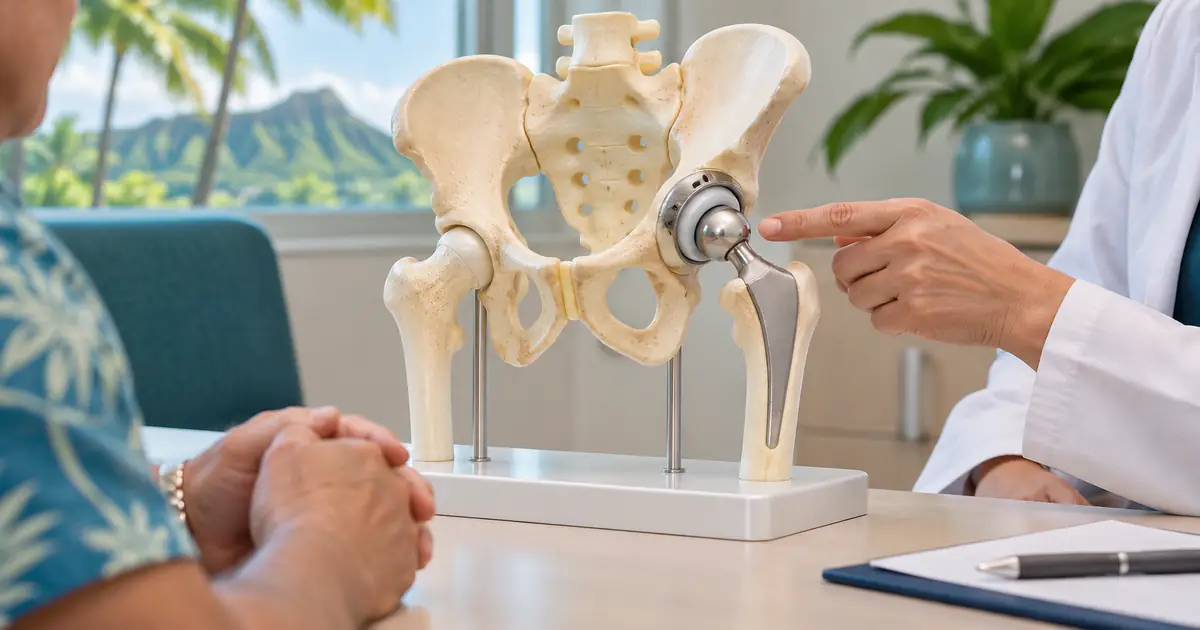
A total hip replacement has a ball attached to a stem in the thighbone and a socket component in the pelvis. Dislocation means the artificial ball is no longer seated in the socket. It differs from a fracture around the implant, component loosening, or routine muscle soreness—even though these problems can sometimes cause overlapping symptoms.
Dislocation is uncommon after hip replacement, and the risk is generally higher in the first months while tissues heal. It can also happen much later, including after a fall or in a hip that has developed instability. One event does not automatically mean the implant has failed or that revision surgery is necessary. [1, 2]
Symptoms that need emergency care
Seek emergency assessment now for sudden severe hip or groin pain, an inability to bear weight, a leg that seems shortened or unusually rotated, a visible change in leg position, or a painful pop followed by loss of movement. New numbness, weakness, a cold foot, an open wound, or significant trauma heighten the urgency. Call 911 when you cannot move or travel safely.
Do not repeatedly test whether the leg can support your weight. Do not let a family member pull, twist, or attempt to relocate the hip. A fracture, nerve or vascular injury, or another emergency may coexist. Even if a dislocated hip seems to move back on its own, a clinician should assess the event and confirm alignment and implant integrity. [1, 4]
What the emergency team usually does
The emergency team checks circulation and nerve function, asks about the original hip replacement and the event, and obtains X-rays to confirm whether the artificial ball is outside the cup and to look for fracture or component damage. If the hip is dislocated without a contraindicating injury, clinicians commonly perform a closed reduction—carefully moving it back into place using anesthesia or procedural sedation.
Reduction is a medical procedure, not a home maneuver. The team generally repeats imaging afterward to confirm the hip is centered and assess for a new fracture or other problem. Some patients require surgery if closed reduction is unsafe or unsuccessful, or when a mechanical obstacle prevents the hip from staying reduced. [1, 2]
Does one dislocation mean you need revision surgery?
Not necessarily. After a first dislocation, a successfully reduced hip may be managed with individually selected activity guidance, sometimes a brace, review of therapy, and close follow-up. Your surgeon will consider when the event occurred, whether there was a fall, whether the hip is now stable, and whether X-rays suggest component damage or malposition.
Because a dislocation can recur, follow-up matters even when pain settles after reduction. Repeated events, persistent instability, an implant that cannot be reduced, associated fracture, or a problem with component position can change the balance toward surgery. The decision should follow a diagnosis, not a predetermined rule based solely on the number of episodes. [1, 2, 3]
Why does a replaced hip dislocate?
Dislocation usually reflects a combination of implant mechanics, surrounding soft tissues, movement, and individual anatomy. Potential contributors include a fall, impingement during a particular motion, the orientation of the cup or stem, inadequate soft-tissue tension, weakness or injury to the abductor muscles, previous revision surgery, and changes in the way the lower spine and pelvis move between sitting and standing.
These factors are not interchangeable. A hip that dislocated during an unusual traumatic event may need a different plan from a hip that repeatedly slips during ordinary activities. No surgical approach makes dislocation impossible, and no isolated imaging measurement can explain every event. [3, 4, 5]
How recurrent instability is investigated
The surgeon reviews the date and details of the original replacement, operative report and implant models, the direction of each dislocation, whether a reduction was performed, and the positions or activities that triggered symptoms. An examination assesses walking, hip motion, muscle function, leg length, and neurologic findings.
Standing and supine radiographs, previous imaging, and sometimes a CT scan can help examine implant orientation, bone, fixation, and possible impingement. Particular cases may require evaluation of spine-pelvis mobility using standing and sitting images. When symptoms suggest infection, loosening, or another process, the team may use laboratory tests, aspiration, or other imaging as appropriate. Testing is individualized; an ordinary dislocation does not automatically mean the joint is infected. [3, 4, 5]
What can revision surgery change?
When investigation identifies a correctable mechanical problem, revision hip replacement may adjust a poorly positioned cup or stem, restore appropriate offset and soft-tissue tension, exchange selected components, repair or reconstruct soft tissues, or use a bearing design intended to improve stability. Dual-mobility constructs or constrained liners may be considered in particular settings, but each has trade-offs and is not a universal solution.
A partial component exchange is sometimes sufficient; other cases require more extensive reconstruction. Revision generally carries greater complexity and risks than the original operation, including infection, recurrent dislocation, fracture, blood clots, and nerve injury. Your surgeon should explain why each component would or would not be changed, and what uncertainty remains. [2, 3, 5]
Precautions after reduction are not one-size-fits-all
After reduction, follow the specific activity, walking, brace, and physical therapy instructions provided by the treating team. The appropriate movements to avoid depend on the direction of dislocation, surgical approach, tissue healing, component position, and whether there is an associated injury. A generic list of restrictions is not a substitute for the surgeon's plan.
Some patients may need temporary limits on deep bending, crossing or twisting positions, low seats, or other movements that reproduce instability; others will have different instructions. Avoid assuming that anterior hip replacement means absolutely zero dislocation risk or that every posterior replacement requires the same permanent restrictions. Ask what activities are safe for your own reconstructed hip. [1, 5]
What to bring to a follow-up consultation
Bring the emergency department discharge paperwork, before-and-after reduction X-rays if available, the original operative report or implant card, your medication list, and a timeline of each slipping or dislocation episode. Note whether you fell, the position you were in, the direction the leg moved, and whether numbness or weakness occurred. You need not delay emergency care to gather records.
For a complex or recurrent problem, the JRH revision joint evaluation program can review the prior surgery and imaging to identify an appropriate next step. A new patient with severe symptoms should go to emergency care first rather than wait for an elective consultation.
Questions worth asking your surgeon
- Was the implant dislocated, or could a fracture or another cause explain the event?
- Do the current images show loose components, fracture, malposition, or wear?
- Would CT or an assessment of spine and pelvis movement change the plan?
- What movements, supports, or therapy are recommended after this specific reduction?
- What signs mean I should return to the emergency department?
- If it recurs, what options besides revision exist, and what would revision correct?
- What are the specific risks, recovery restrictions, and follow-up schedule for the plan being proposed?
The bottom line
A dislocated artificial hip calls for urgent professional assessment, typically with X-rays and, when safe, reduction by a qualified medical team. Do not try to move the ball back into the socket yourself. One episode does not always require revision; recurrent or mechanically explained instability warrants a systematic assessment of component position, soft tissues, bone, and spine-pelvis mechanics.
After the emergency has been handled, review the broader causes of pain after hip replacement, or learn about revision hip options and recovery planning. Treatment decisions and outcomes vary by patient.
Sources and further reading
- [1] AAOS OrthoInfo: Dislocation After Total Hip Replacement
- [2] AAOS OrthoInfo: Revision Total Hip Replacement
- [3] AAHKS HipKneeInfo: Revision Total Hip Arthroplasty
- [4] Why Does a Total Hip Replacement Dislocate? Diagnosis and Management (2025)
- [5] Prevention and Management of Instability After Total Hip Arthroplasty (2025)
Educational information only. A possible dislocation is an emergency and should not be managed based on a website.
Medically reviewed by Paul Norio Morton, MD, FAAOS, FAAHKS. Last reviewed: . This article is for education only and isn’t a substitute for an exam and personalized advice — schedule a consultation to discuss your situation.