
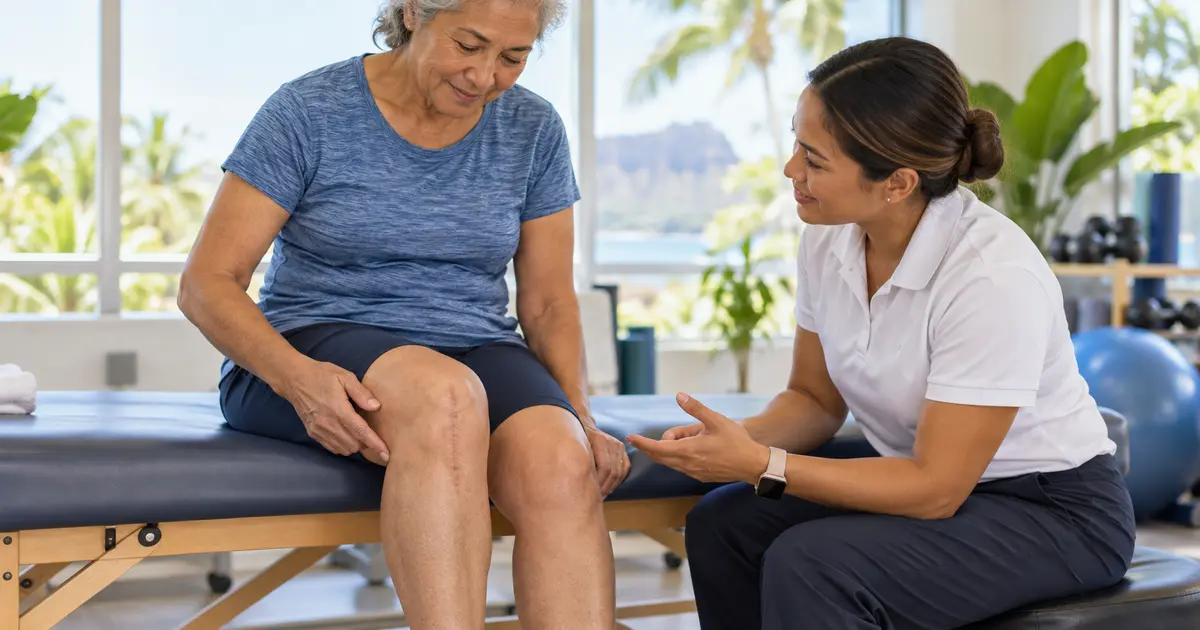
The short answer: a localized numb patch is common
Many people notice reduced feeling in the skin next to the incision after total knee replacement. It is usually a limited patch rather than numbness throughout the whole leg. The outer, or lateral, side of the incision is a typical location. Tingling, pins-and-needles, itching, or extra sensitivity can occur as the area changes.
Prospective research has documented this sensory change after knee replacement and found that the affected area can decrease over time. That pattern is reassuring, but no study can predict exactly how much sensation one person will regain. Read the prospective study of anterior skin numbness.
Why knee replacement can change skin sensation
The nerves that give feeling to the skin form a fine network across the front of the knee. A surgical incision can stretch or divide small superficial branches, including branches that cross toward the outer side of the knee. The result may be an area that feels less sharp, less warm, or simply different from the other knee.
This sensory change involves the skin and does not by itself mean that the implant is loose, the operation failed, or the muscles cannot work. It is also different from an injury to a larger motor nerve, which can cause weakness in ankle or toe movement.
Where an expected numb area is usually felt
The classic pattern is a patch immediately beside the scar, often on its outer side. The border may be irregular and can feel larger early in recovery. Some patients notice it most while dressing, shaving, kneeling, or comparing the knee with the opposite side.
A small stable patch next to a healed incision is different from numbness that extends down the entire leg, wraps around the foot, follows severe back pain, or appears suddenly after a period of normal sensation. Those broader patterns deserve clinical review rather than being assumed to come from the skin incision.
How sensation may change over time
The patch commonly evolves over months. It may shrink, become less intense, or fade into the background as the brain adapts. Tingling or brief electric sensations can accompany nerve recovery. Some people continue to have a smaller permanent area of altered feeling even when the knee otherwise functions well.
Recent and earlier studies support improvement in many patients without guaranteeing complete resolution. See the contemporary study of peri-incisional numbness. Recovery should be judged alongside wound healing, swelling, strength, motion, and walking; the JRH knee replacement recovery guide places those milestones in context.
Numbness and hypersensitivity can occur together
One part of the scar area may feel dull while another feels tender, prickly, itchy, or unpleasant when clothing brushes it. That mixed pattern can happen when small sensory nerves are irritated or reorganizing. It does not necessarily indicate a problem with the implant.
Persistent severe burning pain, repeated electric shocks, pain from a light touch that is getting worse, or symptoms that disrupt sleep and therapy should be discussed with the surgical team. A focused examination can help distinguish ordinary scar sensitivity from a painful neuroma, complex regional pain syndrome, referred symptoms from the back, or another cause.
Protect numb skin from heat, cold, pressure, and sun
Reduced sensation lowers the skin's warning system. Check the area visually after exercise, kneeling, braces, compression garments, or prolonged pressure. Avoid heating pads, very hot baths, ice directly on the skin, and any temperature you cannot reliably feel. Wrap cold therapy, follow the prescribed duration, and inspect the skin afterward.
Protect a healed scar from sun exposure because new scar tissue can darken or burn. Do not apply lotions, oils, adhesive products, or scar treatments until the incision is fully closed and the surgical team says they are appropriate.
Scar massage and desensitization should wait for clearance
Do not massage an open, draining, scabbed, or recently closed incision. Once the wound is fully healed and the surgeon or therapist has cleared scar work, gentle touch may help the skin tolerate normal contact. A therapist may suggest progressing from a soft material to slightly different textures, light tapping, or gentle massage around the scar.
The goal is comfortable exposure, not forcing sensation to return. Stop if the skin becomes red, opens, swells more, or develops escalating pain. Do not use aggressive pressure or a device across the incision without individualized guidance.
Kneeling may feel strange even after the knee is healed
Scar numbness and sensitivity can make kneeling uncomfortable or uncertain. Research on patient-reported numbness has found an association with kneeling difficulty, although many factors—including swelling, strength, confidence, and the surface—also matter. Review the study of numbness and patient experience.
After the incision is fully healed and the surgical team has cleared kneeling, start on a thick clean pad, use support for getting up, and keep the first attempts brief. Inspect numb skin afterward because it may not signal excessive pressure. Kneeling discomfort alone does not usually mean the implant is being damaged, but individual restrictions take priority.
Keep working on motion, strength, and walking
A localized sensory patch does not usually prevent the muscles from strengthening or the knee from bending. Continue the walking and exercise progression prescribed by the surgeon and physical therapist. Do not stop rehabilitation solely because the skin beside the scar feels different.
Modify an activity if direct contact irritates the scar or numb skin. A therapist can adjust positioning while preserving the goal of the exercise. AAHKS provides a general home-exercise overview, but it does not replace the plan for your operation. See the AAHKS home therapy exercises.
Call promptly for weakness, spreading numbness, or circulation changes
Contact the surgical team promptly for new weakness lifting the foot or toes, foot drop, numbness that is rapidly spreading or affects most of the leg, severe or escalating nerve-like pain, or symptoms that began after a fall or injury. Also call for a foot that becomes unusually cold, pale, blue, or difficult to move.
Call 911 for sudden major weakness, a cold or discolored limb, chest pain, sudden shortness of breath, or symptoms of stroke. These are not routine scar-sensation changes. A stable superficial patch beside the incision can wait for routine discussion; a new motor or circulation problem cannot.
Wound changes are not explained by simple numbness
Skin numbness does not cause drainage, wound opening, spreading redness, fever, or increasing warmth. Contact the surgical team for any of those changes, especially when pain or swelling is worsening rather than gradually improving. Do not massage, soak, or cover a changing wound with an unapproved product.
If pain, stiffness, swelling, or instability is the main concern rather than the skin sensation, a broader knee evaluation may be needed. AAHKS explains why persistent pain after knee replacement has several possible causes that require history, examination, and sometimes imaging. Review the AAHKS painful knee replacement guidance.
What the clinical evaluation may include
The clinician may map the numb area, inspect the scar and wound, compare temperature and pulses, and test knee, ankle, and toe strength. The examination may also look for swelling, tenderness, back-related symptoms, medication effects, diabetes or neuropathy, and irritation of a larger nerve.
Bring a simple timeline: when the sensation began, whether its border is shrinking or expanding, what movements trigger symptoms, and whether weakness or wound changes are present. A photo or a light washable outline of the border can help document change, but do not delay urgent care to collect evidence.
A practical scar-sensation checklist
Use this list after a knee replacement while following the instructions for your exact operation and wound.
- Expect that a localized patch beside the incision—often on the outer side—may feel numb or different
- Do not assume that sensation must return completely by a specific date
- Check numb skin after exercise, compression, braces, kneeling, ice, or prolonged pressure
- Never place ice or a heating pad directly on skin with reduced sensation
- Wait until the incision is fully healed and you are cleared before massage, desensitization, soaking, or scar products
- Continue prescribed walking, motion, and strengthening unless the clinical team changes the plan
- Report severe burning pain, spreading numbness, or symptoms that are worsening rather than settling
- Seek prompt care for foot drop, new weakness, a cold or discolored foot, wound drainage, opening, spreading redness, or fever
- Call 911 for sudden major weakness, circulation loss, chest pain, shortness of breath, or stroke symptoms
Get an answer that matches your knee and timeline
A small stable patch by a healed scar often needs reassurance and protection, while a changing wound, motor deficit, circulation problem, or broader pain pattern needs a different response. The distinction depends on an examination, the timing of surgery, and the rest of the recovery.
Schedule a knee replacement consultation with Dr. Morton to review persistent scar sensitivity, recovery progress, kneeling goals, or symptoms that do not fit the expected localized pattern. Urgent neurologic, circulation, wound, or emergency symptoms still require immediate care.
Sources and further reading
Medically reviewed by Paul Norio Morton, MD, FAAOS, FAAHKS. Last reviewed: . This article is for education only and isn’t a substitute for an exam and personalized advice — schedule a consultation to discuss your situation.