
The short answer: possible symptom relief, but not a routine answer
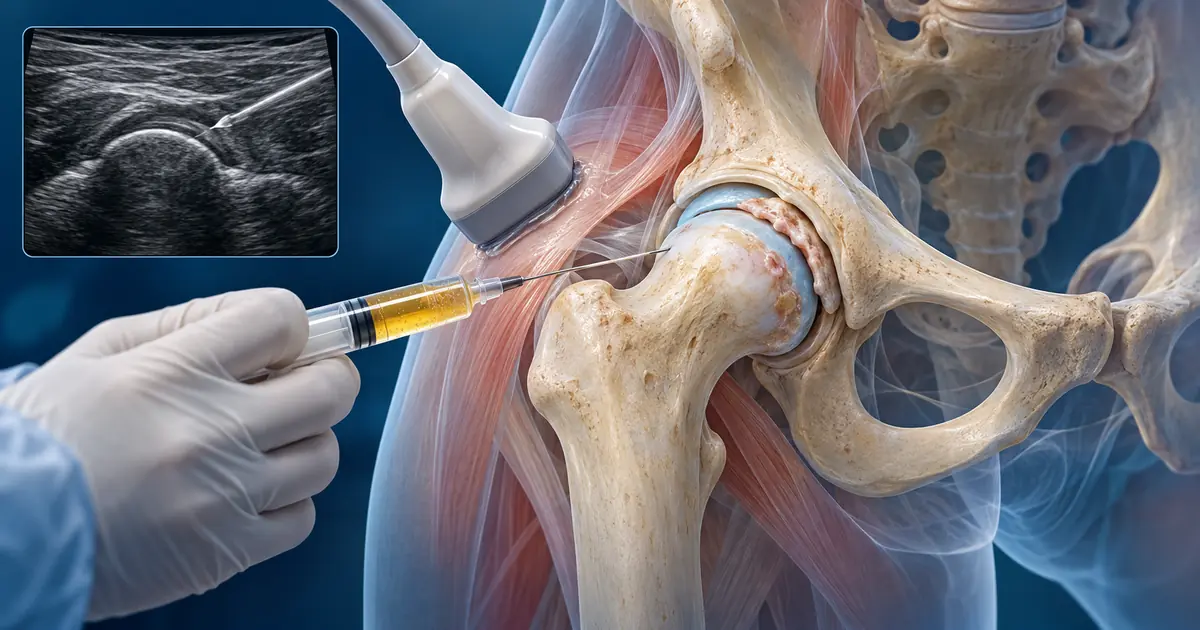
Platelet-rich plasma, or PRP, is made from a sample of your own blood. The platelets are concentrated and injected into the hip joint with imaging guidance. The goal is to change the inflammatory environment around an arthritic joint and reduce symptoms for a time. PRP does not replace missing cartilage, correct a misshapen hip, reverse bone-on-bone arthritis, or guarantee that hip replacement can be avoided.
Research in hip osteoarthritis is much thinner than research in knee osteoarthritis. Several trials report improvement after PRP, but many compare it with hyaluronic acid rather than a true placebo, use different PRP preparations, and enroll small groups. That makes it hard to separate the treatment effect from the natural ups and downs of arthritis, the injection procedure itself, and expectation.
What the hip studies actually show
A 2022 systematic review of six randomized trials included 211 patients treated with PRP and 197 treated with hyaluronic acid. Both groups improved in the short term, but the review found no significant difference between PRP and gel injection on the pooled pain or function measures.
An earlier systematic review found that people receiving PRP often had better scores six and twelve months later, yet PRP was not clearly better than hyaluronic acid. Its authors concluded that the evidence was not strong enough to recommend routine PRP for hip osteoarthritis. The American College of Rheumatology/Arthritis Foundation guideline recommends against PRP for hip and knee osteoarthritis because benefits remain uncertain and PRP products are not standardized.
Newer studies continue to explore the question. A small 2025 randomized trial in patients whose hip arthritis was related to developmental dysplasia found PRP at least comparable with hyaluronic acid, but it did not establish that the same result applies to every cause or stage of hip arthritis. That is promising research context—not proof of universal benefit.
Why evidence for the hip is harder to interpret than evidence for the knee
The hip is deep beneath muscle and other soft tissue. A true intra-articular injection should be placed with ultrasound or fluoroscopic guidance; a blind injection can miss the joint. Hip arthritis also has different mechanical drivers, including dysplasia, impingement, loss of joint space, bone spurs, and deformity of the femoral head or socket. A biologic injection cannot correct those mechanics.
PRP itself is not one uniform drug. Platelet concentration, white-blood-cell content, activation method, number of injections, spacing, and post-injection plan differ among clinics and studies. When one study says “PRP” and another uses a materially different product, combining the results can suggest more certainty than actually exists.
You may be a reasonable candidate for a selective PRP trial if…
PRP may be worth discussing when the diagnosis is secure, arthritis is not end-stage, and the goal is temporary symptom control rather than cartilage restoration.
- Standing X-rays show mild-to-moderate hip osteoarthritis, with meaningful joint space still present
- Pain truly comes from the hip joint rather than the low back, sacroiliac joint, tendon, bursa, or another condition
- Exercise, activity modification, and appropriate medication have not provided enough relief
- You want to postpone—not permanently eliminate—a surgical decision for a defined reason
- You understand that PRP is commonly cash-pay, results vary, and another injection may not help if the first produces little meaningful change
- The injection will be performed with image guidance and followed by a functional rehabilitation plan
PRP is less likely to help—and may waste time or money—if…
The more advanced the structural problem, the less plausible it is that an injection will change what limits you. A candid consultation should identify when the joint has moved beyond what symptom-modifying injections can reasonably accomplish.
- X-rays show advanced bone-on-bone arthritis, major femoral-head or socket deformity, collapse, or substantial loss of joint space
- Pain is severe at rest or at night and daily function keeps shrinking despite well-delivered nonoperative care
- You cannot put on shoes, walk necessary distances, sleep, work, or perform basic activities because of the hip
- A diagnostic injection or examination suggests the pain is mainly from the spine, tendons, bursa, or another source
- There is active infection, a significant blood disorder, severe anemia or thrombocytopenia, active cancer treatment, or another medical reason the clinician considers unsafe
- The clinic promises cartilage regrowth, guaranteed avoidance of replacement, or a fixed package before confirming the diagnosis and arthritis stage
PRP cannot repair a mechanical hip problem
Osteoarthritis pain has both biological and mechanical components. PRP may influence inflammatory signaling, but it cannot deepen a shallow socket, reshape an impinging femoral head, restore lost joint space, or remove large bone spurs. It also does not treat avascular necrosis in the same way as a joint-preservation procedure; that is a different diagnosis with a different decision tree.
This is why an examination and current imaging matter more than the injection menu. The starting point is a diagnosis through a proper orthopedic consultation, not a cash-pay procedure chosen from symptoms alone.
How PRP compares with the other choices before hip replacement
| Option | Main goal | What it cannot do | Key tradeoff |
|---|---|---|---|
| Physical therapy and exercise | Improve strength, motion, gait, and load tolerance | Restore lost cartilage | Requires consistent work; often the foundation regardless of injection choice |
| Anti-inflammatory medication | Reduce pain and inflammation | Correct joint damage | Kidney, stomach, heart, blood-pressure, and medication-interaction risks must be individualized |
| Corticosteroid injection | Short-term relief of an inflammatory flare and sometimes diagnostic clarification | Rebuild the joint | Benefit may be temporary; timing matters if replacement may be approaching |
| PRP | Attempt temporary symptom improvement using concentrated autologous platelets | Regrow cartilage or reliably delay replacement | Evidence is uncertain, preparations vary, and insurance commonly does not cover it |
| Hip replacement | Replace the damaged bearing surfaces in advanced symptomatic arthritis | Guarantee a complication-free result | It is surgery, but it directly addresses end-stage joint damage rather than temporarily modifying symptoms |
The broader menu of joint injections, physical therapy, and arthritis care is individualized around health history, imaging, goals, and response—not a universal ladder that every patient must exhaust.
Does PRP regrow hip cartilage or delay replacement?
No high-quality evidence shows that PRP regrows a clinically meaningful layer of hip cartilage. Symptom improvement, when it occurs, does not prove that the joint surface has been restored. A person can feel better for months while the underlying arthritis remains.
PRP has also not been proven to delay hip replacement by a predictable number of months or years. It may buy useful time for a responder, but that is different from changing the disease course. Ask any clinic that claims otherwise to show the peer-reviewed, hip-specific evidence and explain whether it measured symptoms, cartilage structure, or actual time to surgery.
What a careful PRP consultation should include
A responsible visit starts with the problem, not the product. Expect a history of where the pain is felt, what movements trigger it, how far you can walk, whether the back or knee contributes, and which treatments have already been tried. The examination should assess hip motion, gait, strength, and competing pain sources. Current X-rays usually determine arthritis severity; an MRI is not automatically necessary for straightforward osteoarthritis.
If PRP remains reasonable, discuss how the product is prepared, whether it is leukocyte-poor or leukocyte-rich, how many injections are proposed and why, how the hip will be targeted, what medicines or supplements may need review, the full cash price, and the specific outcome that will define success. “Less pain” is too vague. Walking farther, sleeping through the night, returning to a selected activity, or reducing rescue medication can be tracked.
Image guidance is not optional for an intra-articular hip injection
The hip joint is too deep to treat like a superficial tendon or an easily palpated knee. Ultrasound or fluoroscopy lets the clinician identify the femoral head and neck, avoid important blood vessels, and confirm the needle reaches the joint. Image guidance does not make PRP effective by itself, but it reduces uncertainty about whether the intended target was reached.
Ask what type of guidance will be used and who performs the injection. If a clinic proposes a blind hip-joint injection, request an explanation or seek another opinion.
What recovery and follow-up may look like
Protocols vary. Temporary soreness after injection is common, and improvement—if it occurs—may take weeks rather than hours. Your clinician should give specific instructions about activity, anti-inflammatory medicines, ice, and when to resume strengthening. Do not copy a knee-PRP schedule or another clinic’s instructions without checking; preparation and treatment plans differ.
A planned follow-up is important. If function meaningfully improves, the benefit and duration can guide future decisions. If there is no worthwhile change after an adequate observation period, repeating the same cash-pay procedure indefinitely is difficult to justify. A poor response can be useful information that the pain source was wrong, the joint is too advanced, or a different treatment is needed.
When to move from injection shopping to a hip-replacement conversation
The decision for hip replacement is based on the whole picture: pain, function, imaging, health, goals, and whether reasonable nonoperative care still provides acceptable life—not on a single X-ray or a required number of failed injections. You do not have to suffer until you cannot walk, and you do not have to schedule surgery simply because an image shows arthritis.
It is time for a serious hip-replacement discussion when pain and stiffness consistently limit daily life, nonoperative treatment no longer earns enough relief for its burden or cost, imaging confirms advanced joint disease, and you are ready to weigh the risks and expected benefits of surgery. A consultation can end with “not yet.” Its purpose is clarity, not pressure.
A decision checklist before paying for PRP
Before scheduling a hip PRP injection, make sure you can answer:
- What is the exact diagnosis, and what evidence shows the pain is inside the hip joint?
- How advanced is the arthritis on current imaging?
- What realistic functional goal are we trying to achieve?
- What does the best hip-specific evidence show—not knee evidence borrowed for the hip?
- How is this PRP prepared, and why was this protocol chosen?
- Will ultrasound or fluoroscopy confirm intra-articular placement?
- What is the complete out-of-pocket cost?
- When will we decide whether it worked, and what is the plan if it does not?
- Would a steroid injection, physical therapy adjustment, medication change, or surgical evaluation better match the current problem?
The bottom line
PRP for hip arthritis sits in a narrow middle ground. It may be a reasonable, carefully explained trial for some people with confirmed mild-to-moderate osteoarthritis who still have joint space, want symptom relief, and understand the uncertainty and cash-pay cost. It is not a cartilage-regrowth treatment, a routine guideline-backed therapy, or a reliable rescue for a severely damaged hip.
Dr. Paul Morton evaluates the diagnosis and stage before recommending an injection or operation. If you are deciding between more conservative care, PRP, or hip replacement, schedule a consultation or call (808) 439-6201. Bring prior hip imaging, a medication list, and a short record of what treatments helped, what failed, and what activities you want back.
Sources and further reading
- Belk et al.: PRP versus hyaluronic acid for hip osteoarthritis—systematic review and meta-analysis
- Berney et al.: PRP injections for hip osteoarthritis—review of the evidence
- American College of Rheumatology/Arthritis Foundation osteoarthritis guideline summary
- AAHKS patient guidance: PRP for hip and knee osteoarthritis
- Okanoue et al.: PRP versus hyaluronic acid in dysplasia-related hip osteoarthritis
Medically reviewed by Paul Norio Morton, MD, FAAOS, FAAHKS. Last reviewed: . This article is for education only and isn’t a substitute for an exam and personalized advice — schedule a consultation to discuss your situation.