
The short answer: the dressing determines the first shower
There is no universal postoperative day when every patient should shower. Some sealed, waterproof dressings permit an early shower if their edges are intact. A standard dressing may need to remain dry until it is removed or changed. AAHKS notes that patients with a standard dressing may be asked to avoid showering for about five to seven days, while the exact plan depends on the surgeon, wound closure, and dressing. Review the AAHKS knee replacement guidance.
Your own discharge instructions take priority. Before leaving the surgical facility, ask whether the dressing is waterproof, when it should come off, whether it may be reinforced, and what to do if water gets underneath it.
Showering is different from soaking
A shower allows water to run off the body. A bath, hot tub, pool, or ocean submerges the incision and exposes it to water for longer. Even when a shower is permitted, soaking usually is not. AAHKS advises avoiding soaking for several weeks so the incision can fully heal. See the AAHKS hip replacement guidance.
Do not use a calendar date alone to decide when to soak. The incision should be fully closed, with no open area, scab, drainage, or increasing redness, and the surgical team should clear the activity. Ocean water adds bacteria, sand, uneven footing, and waves, so an ocean return may reasonably come after a controlled pool return.
Protect the incision without scrubbing it
Follow the instructions for the exact dressing and closure used. Do not peel up a sealed dressing to look underneath it, puncture it, or add unapproved creams, powders, alcohol, peroxide, or antibiotic ointment. If the incision itself is allowed to get wet, let water run gently over it rather than aiming a high-pressure spray at the wound. Do not scrub.
After the shower, use a clean towel to pat the permitted area dry. Do not rub across the incision or dressing. MedlinePlus advises keeping the dressing clean and dry and changing it according to the surgeon's instructions, including when it becomes dirty or wet. Read the hip replacement discharge instructions.
Know what to do if the dressing gets wet
A few drops on the outside of an intact waterproof dressing are different from water collecting underneath it. If a dressing lifts, leaks, becomes saturated, or traps water against the incision, contact the surgical team for instructions. Do not leave a wet dressing against the wound and do not improvise a complicated dressing change unless you were taught how.
Call promptly for new drainage, wound opening, spreading redness, increasing warmth, fever, chills, or pain that is worsening instead of improving. AAHKS identifies persistent drainage and suspicious wound changes as reasons for early communication because the skin barrier protects the joint from infection. Review AAHKS infection warning signs.
Set up the bathroom before surgery
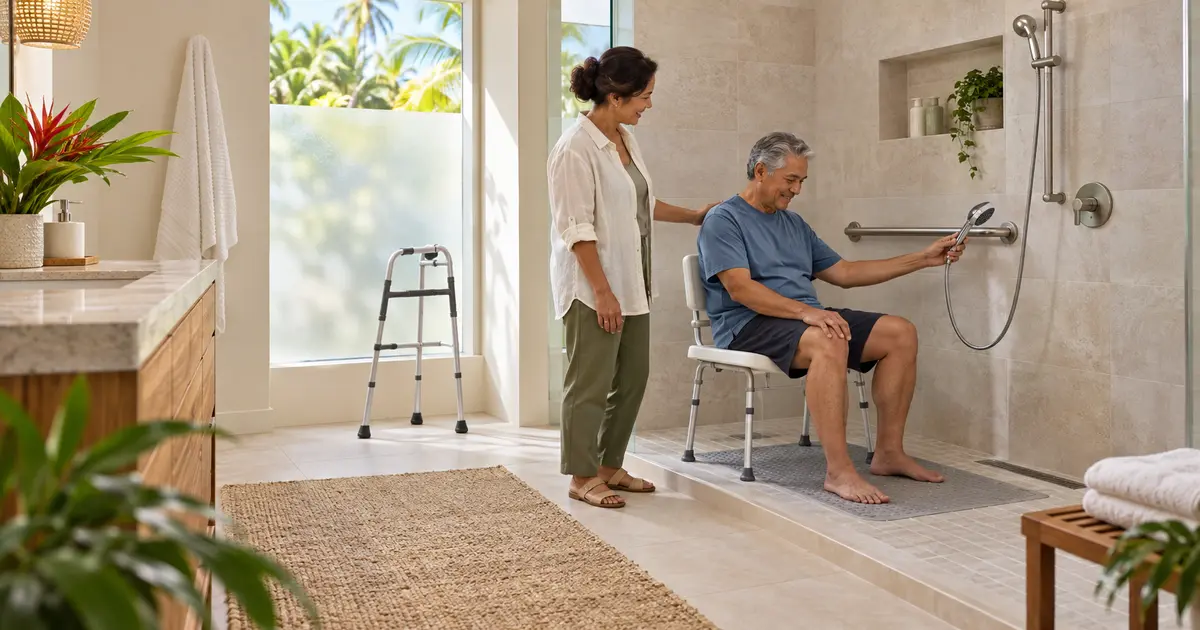
Place soap, shampoo, a clean towel, and clothing where they can be reached without twisting, bending deeply, or standing on one leg. Keep the route wide enough for the walker. Remove loose rugs and clutter. Use good lighting, including for nighttime bathroom trips.
MedlinePlus recommends a nonslip surface inside the shower or tub, a non-skid mat outside, a dry floor, and supplies positioned within easy reach. Use its home-preparation checklist. The JRH fall-prevention guide covers the rest of the home.
Use a shower chair and real grab bars when needed
A shower chair or transfer bench can reduce the time spent standing on a wet surface. The seat should be stable, fit the shower, and have intact nonslip feet. A handheld shower head can help you wash while seated. Securely installed grab bars may help with entry, exit, and standing.
Never use a towel rack, shower door, soap dish, or walker as a substitute for a grab bar. MedlinePlus specifically warns that towel racks cannot support body weight and recommends properly installed safety bars. See its bathroom safety guidance.
Practice the transfer while everything is dry
Ask physical or occupational therapy to practice the exact transfer required by your bathroom. A walk-in shower, tub-shower combination, narrow doorway, high threshold, and sliding door each create different challenges. Practice before the first real shower, with the chair and mobility aid in their planned positions.
Do not step backward over a tub wall, pivot quickly on the operated leg, or pull on another person's neck or arms. Move slowly, use the prescribed walker until you reach the stable transfer point, and have the helper follow the technique taught by therapy.
The first shower should not be a solo test
For the first shower, have another adult nearby if possible. The helper can keep the floor dry, pass supplies, steady equipment, and remain available if you become dizzy or tired. Privacy still matters; the helper can wait just outside the door if hands-on assistance is unnecessary.
Choose a time when pain is controlled but you are alert. Opioids, muscle relaxants, sleep medicines, reduced food intake, dehydration, and blood-pressure changes can all reduce the safety margin. If you feel lightheaded while sitting or standing, stop and postpone the shower rather than pushing through.
Hip and knee patients may need different transfer strategies
After knee replacement, bending the knee over a tub wall or controlling the descent to a low seat may be difficult early on. After hip replacement, the safest motion depends on the surgical approach and any specific precautions. Dr. Morton's direct anterior hip patients often have fewer positional restrictions, but that does not eliminate weakness, fatigue, or fall risk.
Follow the precautions given for your operation rather than copying another patient's technique. If the bathroom setup cannot be used safely, a temporary sponge bath is better than forcing an unsafe transfer.
When can I return to the pool, hot tub, or ocean?
Wait until the incision is completely sealed and the surgical team has cleared immersion. AAHKS commonly describes avoiding soaking for approximately three to four weeks with a standard dressing, but individual wound healing can be faster or slower. Drainage, a scab, a small opening, or a recent dressing problem means the barrier is not ready.
Return in stages. A clean pool with an easy stair or ramp is more controlled than a hot tub, beach entry, rocky shoreline, boat ladder, or surf. Ocean activities require balance on sand and uneven ground in addition to wound readiness. The JRH knee replacement recovery guide explains how water activity fits into the broader recovery timeline.
When to call the surgical team
Call for a dressing that is saturated, lifted, or leaking; water trapped under the dressing; new or increasing drainage; an opening in the incision; spreading redness; worsening warmth or swelling; fever or chills; a foul odor; or pain that is increasing rather than gradually improving. Do not wait for the next routine visit when the wound is changing.
Call 911 for a fall with loss of consciousness, severe bleeding, chest pain, sudden shortness of breath, an obvious deformity, a cool or numb limb, or pain so severe that you cannot move safely. For non-emergency concerns, a clear photo and a description of when the dressing or wound changed can help the surgical team triage the problem.
A first-shower checklist
Use the discharge instructions for your operation and dressing first. Before turning on the water, confirm each item below.
- Confirm that your exact dressing and incision plan permits a shower
- Keep baths, hot tubs, pools, and ocean water off-limits until the incision is fully sealed and you are cleared
- Place soap, shampoo, towels, and clothing within seated reach
- Use a stable shower chair or transfer bench if recommended
- Use properly installed grab bars, never a towel rack or shower door
- Keep a nonslip surface inside and a dry, non-skid surface outside the shower
- Practice the transfer while the bathroom is dry
- Have another adult nearby for the first shower
- Pat dry; do not scrub, peel, or add unapproved products to the incision
- Know whom to call if the dressing leaks, the wound drains, or the incision opens
Get a bathroom plan that matches your home
A safe plan depends on the dressing, wound, mobility aid, surgical approach, bathroom layout, and available help. If your shower requires stepping over a tub wall, the doorway is too narrow for the walker, or you have already had a near-fall, ask for a focused transfer and equipment review before surgery or discharge.
Schedule a joint-replacement planning consultation with Dr. Morton to review wound-care instructions, bathroom equipment, caregiver support, and the timing of pool or ocean activities. Urgent wound or emergency symptoms still require immediate clinical care.
Sources and further reading
Medically reviewed by Paul Norio Morton, MD, FAAOS, FAAHKS. Last reviewed: . This article is for education only and isn’t a substitute for an exam and personalized advice — schedule a consultation to discuss your situation.