
The short answer: a root tear is different from a routine meniscus tear
The meniscus is a C-shaped cartilage structure that helps spread load across the knee. Each meniscus is anchored to the tibia at anterior and posterior roots. A root tear is usually an avulsion from that anchor or a radial tear close enough to the attachment that the circular “hoop” function is interrupted.
That distinction matters. A small tear elsewhere may leave much of the meniscus working. A complete root tear can allow the meniscus to extrude outward and stop distributing load effectively, increasing stress on the articular cartilage. The goal of root repair is to restore the attachment and preserve function—not simply to remove torn tissue.
Symptoms can be sudden, subtle, or mixed with arthritis
Some people recall a painful pop while squatting, climbing stairs, rising from a low chair, or making a minor twist. Others develop inner or back-of-knee pain without one clear injury. Swelling, pain with weight bearing, difficulty bending deeply, and tenderness along the joint line are common, but none is specific to a root tear.
Root tears often occur in middle-aged or older adults and may coexist with cartilage wear. Lateral root tears are also seen with ligament injuries, especially ACL tears. The examination should therefore ask whether the root tear explains the symptoms or is one part of a broader knee problem.
MRI finds the tear; standing X-rays show the environment around it
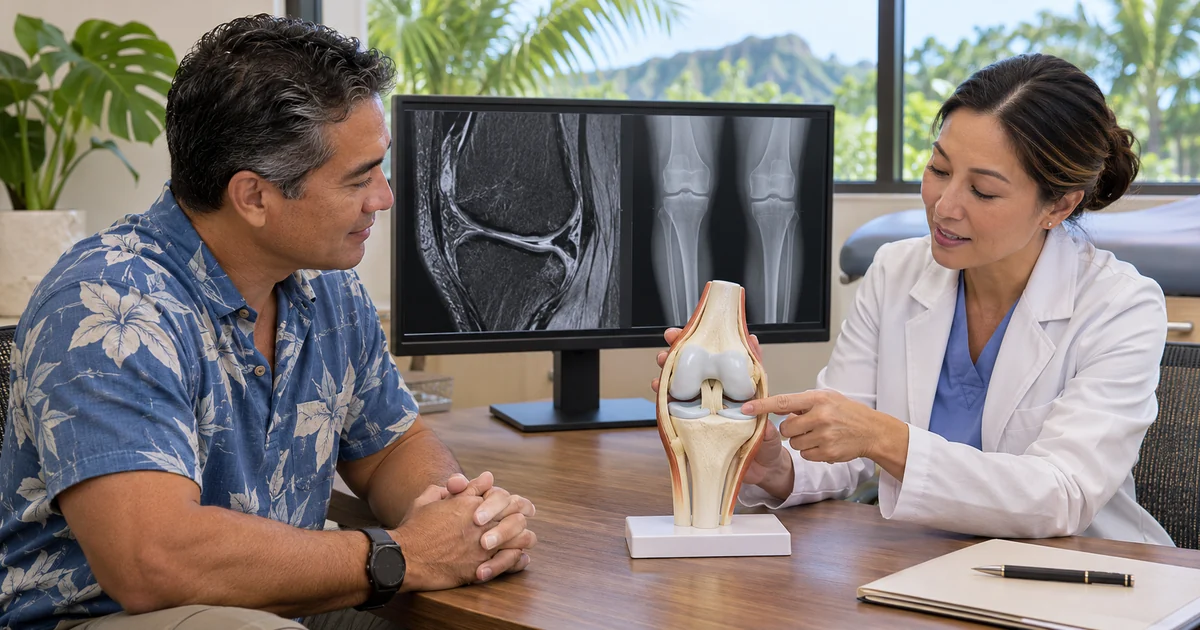
MRI is the main imaging test for visualizing the root attachment, tear pattern, meniscal extrusion, bone-marrow changes, cartilage, and associated ligament injury. Reviews describe signs such as loss of the normal meniscal signal at the root, a radial defect, extrusion, and the sagittal “ghost” sign.
MRI does not replace weight-bearing radiographs. Standing knee views help show joint-space loss and the degree of osteoarthritis under load. A long-leg alignment image may be used to assess bow-legged or knock-kneed alignment. Together, MRI and standing X-rays answer different questions: what is torn, how much cartilage remains, and what forces will act on a repair.
Not every MRI root tear needs surgery
Treatment is based on symptoms and the whole knee, not on an imaging label alone. An incidental or minimally symptomatic tear may be observed. Nonoperative care can include activity modification, physical therapy, weight management when appropriate, medication used safely, and sometimes an unloader brace or injection for symptom control.
Nonoperative treatment does not reattach the root, and it may not prevent arthritis from progressing. It may still be the better choice when symptoms are manageable, medical risk is high, rehabilitation restrictions are unrealistic, or advanced arthritis makes a biologic repair unlikely to solve the main problem.
What makes someone a possible repair candidate
Recent reviews and expert consensus support considering repair for a symptomatic root tear when the knee does not have advanced osteoarthritis and the patient can follow a protected recovery. Selection is individualized rather than based on age alone.
- Symptoms that fit the involved compartment and persist despite appropriate initial care
- MRI confirming a repairable root tear and showing the cartilage and other structures
- Standing X-rays without advanced compartment collapse
- Alignment that is acceptable or can be addressed in the treatment plan
- A stable knee or a plan to treat associated ligament instability
- Medical health and bone quality adequate for surgery and healing
- Ability to use crutches, limit weight bearing, and follow motion restrictions during early rehabilitation
- Realistic expectations that repair may reduce risk but cannot guarantee cartilage recovery or prevent future arthritis
Advanced arthritis can change the operation
When the involved compartment already has substantial joint-space loss, exposed bone, or diffuse cartilage damage, repairing the root may not address the dominant pain generator. Severe malalignment, instability, or focal cartilage loss also changes the prognosis and may require a combined or different strategy.
Depending on the pattern, options may include continued nonsurgical care, an alignment-correcting osteotomy in selected joint-preservation cases, cartilage or ligament treatment, or partial or total knee replacement when arthritis is advanced. The correct question is not “Can the root be stitched?” but “Which plan best treats this knee as it exists today?”
How a root repair is performed
Most posterior root repairs are performed arthroscopically. The surgeon inspects the cartilage, confirms the tear and its mobility, prepares the bony attachment, and passes sutures through the meniscus. In a common transtibial pull-out technique, the sutures pass through a small tunnel in the tibia and are fixed on the front of the bone to hold the root at its anatomic attachment while it heals.
Other fixation and centralization techniques may be considered for particular patterns. The operation chosen depends on which root is torn, tissue quality, extrusion, anatomy, associated procedures, and surgeon judgment. No technique can reverse established arthritis, and healing is not guaranteed.
Why simply trimming the root tear is approached cautiously
Partial meniscectomy can remove an unstable fragment and may relieve mechanical symptoms, but it cannot restore the root’s load-sharing function. Contemporary observational studies and systematic reviews report less arthritis progression and fewer conversions to knee replacement after repair than after partial meniscectomy in appropriately selected medial-root-tear patients.
Those comparisons are not randomized proof that every patient should have a repair. The studies vary in selection, technique, arthritis severity, and follow-up, and repair cohorts are often healthier knees. The useful lesson is that preserving functional meniscus matters when the tissue and joint remain repairable—not that repair guarantees avoidance of arthritis or replacement.
Recovery is more protective than after a simple meniscus trim
A root repair must heal to bone while avoiding excessive load and deep loaded bending. Protocols vary, and reviews have not identified one universal schedule. Many programs use a brace, protected motion, and little or no weight through the operated leg for about six weeks, followed by gradual progression.
Running, pivoting, deep squatting, and heavy loaded flexion return later than after partial meniscectomy. A systematic review found substantial variation in when motion and weight bearing begin, while contemporary rehabilitation reviews support a more conservative early pathway for root and complete radial repairs. Follow the operation-specific written protocol rather than a generic meniscus timeline.
Alignment and combined procedures deserve a separate conversation
Varus, or bow-legged, alignment can increase load through a medial root repair. Significant malalignment may worsen healing or ongoing compartment stress. In selected joint-preservation patients, an osteotomy may be considered to redistribute load, either with or apart from root repair.
ACL reconstruction, cartilage restoration, or another meniscus repair can also change rehabilitation. When procedures are combined, the most protective restriction usually governs. Ask which structure is setting the weight-bearing, brace, and motion limits.
Questions to ask at a root-tear consultation
A useful consultation makes the decision logic visible. Ask to review the MRI and standing X-rays together.
- Is this a true root tear, and which root is involved?
- Does the tear explain my symptoms, or is arthritis the main pain source?
- How much meniscal extrusion and cartilage damage are present?
- What do the standing and alignment X-rays show?
- Am I a repair candidate, and which findings support or argue against repair?
- Would alignment, ligament, or cartilage treatment need to be combined with the repair?
- What are the alternatives if I do not have surgery?
- What weight-bearing, brace, and motion restrictions should I expect?
- What would make the operation change after arthroscopic inspection?
- What are the realistic risks of persistent pain, failed healing, arthritis progression, and later surgery?
Call promptly for concerning symptoms
Seek prompt evaluation for a knee that locks and cannot straighten, rapidly increasing swelling after an injury, inability to bear weight, fever with a hot or red joint, a new deformity, or calf swelling and pain. After surgery, contact the surgical team for increasing drainage, wound opening, fever with worsening knee symptoms, new numbness or weakness, a fall, or pain that suddenly escalates.
Call 911 for chest pain, severe shortness of breath, fainting, or stroke symptoms. A root tear itself is rarely an emergency, but other causes of acute knee pain and postoperative symptoms may require urgent care.
The bottom line
Meniscus root repair can be a joint-preserving option when a symptomatic tear is identified before advanced arthritis dominates the compartment and the knee is suitable for healing. The decision requires more than an MRI: standing arthritis, alignment, cartilage, stability, health, goals, and the ability to complete protected rehabilitation all matter.
Learn more in the meniscus repair guide, review how knee arthroscopy is used selectively, or schedule an orthopedic consultation for an individualized review. Recommendations, timelines, and outcomes vary by patient.
Sources and further reading
- AAOS OrthoInfo: Meniscus Tears
- AAOS Clinical Practice Guideline: Acute Isolated Meniscal Pathology (the guideline explicitly excludes root tears; it is cited only for general meniscus diagnosis and preservation principles)
- Meniscus root tears: state of the art. World J Orthop. 2024.
- Meniscal Root Tears: Epidemiology, Diagnosis, Management, and Outcomes. J Am Acad Orthop Surg. 2026.
- Medial Meniscus Root Repair Is Associated With Superior Outcomes Compared With Partial Meniscectomy at Minimum 5 Years: Systematic Review and Meta-analysis. 2026.
- Rehabilitation after Repair of Medial Meniscus Posterior Root Tears: A Systematic Review. Clin Orthop Surg. 2023.
Medically reviewed by Paul Norio Morton, MD, FAAOS, FAAHKS. Last reviewed: . This article is for education only and isn’t a substitute for an exam and personalized advice — schedule a consultation to discuss your situation.