
Locations
Hip & knee replacement in Hilo, East Hawai‘i
Raised in Kea‘au, about ten miles away, Dr. Morton sees hip and knee patients from across East Hawai‘i at this clinic. Most routine replacements happen on the same street, at Hilo Community Surgery Center, with no flight to O‘ahu.
Online scheduling opens Klara, our secure booking service; a real person confirms within one business day.

Paul N. Morton, MD, FAAOS
Fellowship-trained hip & knee replacement surgeon in Hawai‘i ·About Dr. Morton
- Board CertifiedAmerican Board of Orthopaedic Surgery
- Adult Reconstruction FellowshipHip & knee replacement · University of Chicago
- AO Trauma FellowshipCharité – Universitätsmedizin Berlin
- FAAOSFellow, American Academy of Orthopaedic Surgeons
- FAAHKSFellow, American Association of Hip and Knee Surgeons
- MD, University of Hawai‘iJohn A. Burns School of Medicine (JABSOM)
Why East Hawai‘i patients come to this clinic
Dr. Paul Morton grew up on this side of the island. He finished Kea‘au High School, about ten miles from this office, and earned his MD in 2012 at the University of Hawai‘i’s John A. Burns School of Medicine, with half of his third-year clinical work on Hawai‘i Island. Fellowship training in adult reconstruction at the University of Chicago covered primary and robotic hip and knee replacement and complex revision; a second fellowship, with AO Trauma at Charité – Universitätsmedizin Berlin, focused on complex fractures, including those around implants. He is board certified in orthopedic surgery and a Fellow of the AAOS and the AAHKS.
Hip and knee replacement, including fixing replacements done elsewhere, is the core of his practice. On March 3, 2022, at Kona Community Hospital, he performed Hawai‘i Island’s first robotic joint replacement. This clinic followed, so people in Hilo, Kea‘au, Pāhoa, Puna, Volcano, Honoka‘a and Waimea can see him without leaving the island; his biography has more.
What happens at the Hilo clinic
Most of your care before and after an operation happens in this office: the first consultation and exam, injections and other nonsurgical arthritis treatment, your pre-operative visit, and checkups after surgery. Dr. Morton is in Hilo on scheduled clinic days, which can shift, so ask the office at (808) 439-6201 for the next ones. In between, telehealth fills the gap: the office texts a Doximity link to your iPhone or Android phone, and these video visits are for patients who are in Hawai‘i during the call. You are still examined in person before any operation.
New X-rays or an MRI can be ordered at Hilo-area facilities, and scans from other Hawai‘i imaging centers usually reach your chart electronically. With copies of earlier studies at hand, you can also upload your images (opens in a new tab), so they are on hand before you arrive. An upload is not a consultation or a read of your films, and it does not reserve a visit.
Partial or total knee, and the approach to each joint
Some worn knees need only part of the joint replaced. A partial knee deserves a look when the damage is limited to one compartment, your ACL is sound, you can straighten the knee well, and therapy, medicines and injections are no longer enough. Dr. Morton does all four kinds: medial, lateral, patellofemoral and bicompartmental. Your exam and standing X-rays decide it; age by itself does not. The trade-off is that a partial carries a somewhat higher chance of another operation during your lifetime, as partial versus total explains.
He reaches nearly every total knee through the quadriceps-sparing subvastus approach, and first-time knees are done tourniquet-free. For hips, his standard is the direct anterior approach, which leaves muscle on bone and opens just the joint capsule, so most patients skip hip precautions. A bikini-line incision is possible where your anatomy permits. If earlier surgery, retained hardware or deformity favors another route, he will explain why.
Mako robotic surgery, built on a CT scan of your joint
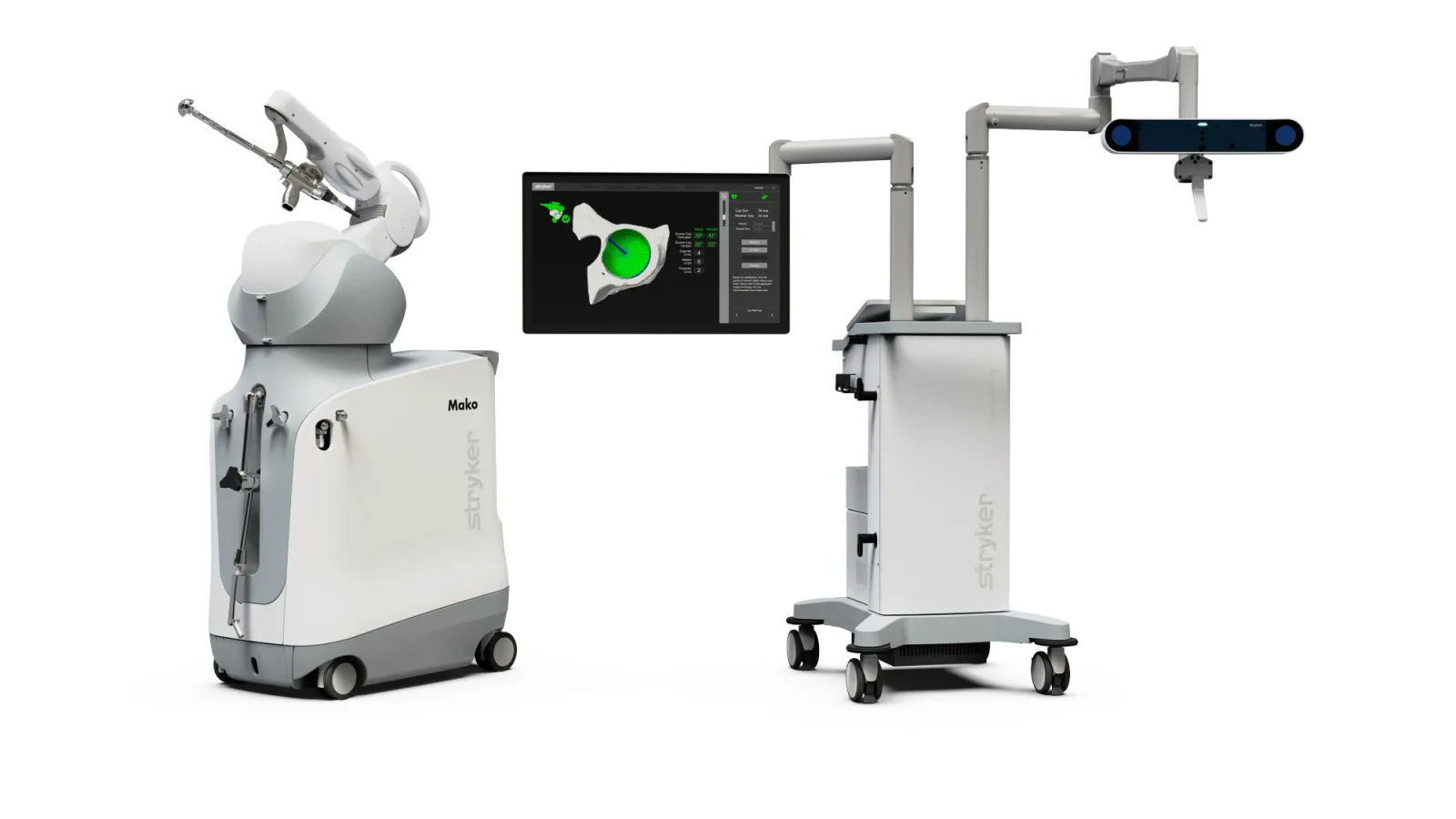
A Mako operation in Hilo starts with a CT scan, done without IV contrast. From it, a 3D model of your own joint is built, and Dr. Morton chooses implant sizes and positions on that model before surgery day; on a hip, he sets leg length, offset, stem size and cup angle. During the operation the arm feeds back alignment and balance as he works and keeps his instruments on that plan. The arm never cuts by itself and decides nothing; Dr. Morton performs every step. Intraoperative X-rays recheck leg length, but no technology can promise a perfect match.
You pay no separate fee for the robot; the surgery is billed like any joint replacement, and your Medicare coverage is unaffected. Mako robotic joint replacement explains the system, and the philosophy page explains why he plans this way.
Revision surgery and second opinions
Other surgeons refer the revision cases that make up roughly half of Dr. Morton’s practice, and his Revision Hip & Knee Clinic regularly sees implants placed elsewhere, the mainland and overseas included. When a replacement aches, gives way or seems loose, evaluation starts at your Hilo visit. Depending on the problem, it may include X-rays set beside older films, ESR and CRP blood tests, joint fluid sent for culture when infection is a concern, and confirming exactly which implant you have, down to model, size and any recall. Surgery is offered only when a cause is found. Call promptly about a possible infection: caught early, some can be treated without removing the implant.
Revisions are done at a hospital, which for Big Island patients usually means The Queen’s Medical Center in Honolulu. For a second opinion, send the image files, not just the radiology reports; Dr. Morton reads them himself, and his written impression with options generally arrives in one to two weeks.
Where surgery is performed
The clinic and Hilo Community Surgery Center share a street, Puuhonu Place, and most routine first-time hip and knee replacements, partial knees included, take place at the surgery center. Surgery there is same-day only, with no overnight stays. Discharge follows milestones rather than the clock: steady on your walker, keeping down food and fluids, and managing pain with tablets. Plan on a companion who drives you home and remains with you, overnight too, through at least the first 24 to 72 hours.
If a night of hospital monitoring could be needed for your health, or the case is a complex reconstruction or revision, a hospital on O‘ahu, such as Queen’s, is booked from the start. The setting follows your procedure, your medical picture and your insurance, and the reasons are explained to you. Dr. Morton decides the surgical plan and operates himself; anesthesia providers, nurses, a physician assistant and therapists handle other parts of your care. Same-day joint replacement describes the day in detail.
How many trips to plan for
With surgery in Hilo, nobody boards a plane. The in-person stops are few and close to home: the consultation and exam at the clinic, your planning CT, a pre-operative visit, the operation, and a first check about a week afterward. Medical clearance normally comes through your regular doctor. If your health calls for blood work or an EKG, the office says so and can set them up; ask whether a lab near you can do them. Many questions in between are answered by video.
For an operation on O‘ahu, one trip covers it in most cases. Since your consultation and imaging are already done in Hilo, that trip folds together the in-person pre-operative exam, final testing, the operation and early recovery. Occasionally a complicated case needs a second trip, and you would know before booking flights. The travel guide lays the steps out in order.
Physical therapy close to home
There is no need to travel for rehab. Pick any licensed physical therapist who is easy for you to reach, at a clinic or one who comes to your house. The office can suggest Hilo-area therapists and sends Dr. Morton’s written rehabilitation protocols to the one you pick, so you both work from the same plan. Expect your first session within a day or two of getting home. Most people lean on a walker for about the first couple of weeks before trading it for a cane, and driving waits for Dr. Morton’s OK, so line up rides.
If you had surgery on O‘ahu, your first sessions usually take place there, and a therapist near Hilo picks up when you get home. Telehealth visits keep the plan current between clinic days. Starting prehab exercises before surgery means you already know many of the movements.
Surgery on O‘ahu: where to stay and when to fly home
Plan on about 10–14 days on O‘ahu after a joint replacement, and book a return flight you can change. You stay through your first check after surgery and fly only once the surgical team clears you, never the same day; the travel guide gives the usual planning range. Choose a hotel or condo that is ADA compliant, with an elevator, easy walking nearby and room for your companion; after your date is set, the care coordinator can suggest recovery-friendly options. Flights and lodging are yours to book, or the Elite Recovery level of the Rapid Recovery Concierge can arrange them, with travel itself paid separately. Ask the office whether your health plan helps with interisland airfare or lodging for medically necessary care.
For the flight home, sit on the aisle, stand and stretch your legs when the cabin allows, sip water, and flex your ankles in your seat. Stick to the clot-prevention plan you were given; flying is no reason for extra aspirin. Your implant will probably set off the walk-through detector; tell the TSA officer which hip or knee was replaced, and no card or letter is needed.
If a problem comes up after surgery
Before you go home you receive written instructions: what to watch for and whom to phone. Weekdays between 8:00 am and 4:30 pm HST, call (808) 439-6201, and the office triages urgent concerns by phone the same day. After hours, reach the Physicians Exchange at (808) 524-2575. For chest pain, sudden breathlessness or fainting, dial 911.
Plenty of worries can be settled without driving in. By phone video, the team can see your incision on camera, go over your progress and change your therapy plan. When an exam in person is needed, the team coordinates with your doctors on the island so you are seen quickly. When to call spells out the warning signs, and wound management covers caring for the incision.
What patients say
“Dr. Morton and his staff has given me excellent pre-op planning for my knee replacement surgery. They explained what the procedure would be and answered any questions I had. The surgery went well, as expected.”
— Max D. · Google review · 2023 “I am currently in my tenth day of recovery and doing quite well. My pain level is almost nil and except for driving I am able to carry on most of my daily living functions. What I like best about Dr Morton is his bedside manner.”
— Diverden59 · Google review · 2026 “Dr. Morton’s PA administered the knee injections. I had some questions, which she answered thoroughly and thoughtfully. Injections also administered carefully.”
— Martine A. · Google review · 2025
Nearby areas we serve
Services at this location
Other clinic locations
Pacific Bone & Joint — Honolulu (Ala Moana)
1441 Kapiolani Blvd, Suite 2020, Honolulu, HI 96814
Serving Honolulu, Waikīkī & East Oahu
Pacific Bone & Joint — West Oahu (Kunia)
94-673 Kupuohi St, Suite C205, Waipahu, HI 96797
Serving Kapolei, Ewa Beach, Waipahu, Pearl City, Mililani & Central Oahu
Pacific Bone & Joint — Kona
75-184 Hualalai Rd, Suite 205, Kailua-Kona, HI 96740
Serving Kailua-Kona, Waimea & West Hawai‘i Island
Frequently asked questions
What is the Hilo clinic’s address, and when is Dr. Morton there?
Is my hip or knee replacement done in Hilo, or on O‘ahu?
Can I stay overnight at Hilo Community Surgery Center?
Between Hilo clinic days, how do I reach the team?
Does Mako robotic surgery in Hilo cost extra or change my Medicare coverage?
Will I need a referral to be seen in Hilo?
I live in Kona. Do I have to come to Hilo?
Can a partial knee replacement be done in Hilo?
Can the Hilo clinic evaluate a replacement another surgeon did?
Take the first step toward moving without pain
Consultations in Honolulu, West Oahu, Hilo and Kona — most new patients are seen within one to two weeks — with telehealth when an in-person visit isn’t practical.
Online scheduling opens Klara, our secure booking service; a real person confirms within one business day.
Paul Norio Morton, MD, FAAOS, FAAHKS · Hawai‘i’s first robotic hip & smart knee · Read patient reviews →
Most major plans accepted — we verify benefits before your visit. Traveling from off-island? See the fly-in patient program →